What Makes Navy Cabinets Work in Ottawa Kitchens


Navy cabinets succeed because they deliver visual depth, act as a neutral anchor across nearly every design style, and hide everyday wear far better than lighter colors. Three rules determine whether they work in your Ottawa kitchen: balance navy with light surfaces (white quartz, pale counters, or light oak), choose an undertone that holds up under your specific lighting conditions, and plan a layered lighting system before you commit to a single can of paint.
Balance with light surfaces. Navy absorbs light; white or cream countertops and walls return it.
Choose the right undertone. Cool navies with green undertones can read gray-blue under LED bulbs. Warm navies with red undertones stay rich.
Plan layered lighting first. Ottawa kitchens with limited south-facing windows need under-cabinet LEDs and ambient fixtures before dark cabinetry goes in.
Table of Contents
What makes navy cabinets work in kitchens, according to color theory?
Which finishes, door styles, and hardware work best with navy?
How do you keep an Ottawa navy kitchen from feeling dark or small?
What paint systems and maintenance routines keep navy looking rich?
What does cabinet refinishing vs. replacement cost in Ottawa?
Ottawacabinetpainting turns existing cabinets into a navy showpiece
Useful sources for Ottawa homeowners researching navy cabinets
What makes navy cabinets work in kitchens, according to color theory?
Navy sits at a unique intersection in color theory: it reads as a neutral in the way black does, but without the severity. Navy provides the richness of black without the harshness, which is why designers pair it with white quartz and brass hardware for a high-end look that still feels livable.
The contrast effect is real and measurable. Blue kitchen environments have been linked to more mindful eating habits and are particularly effective for evening entertaining. Dark cabinets also make plated portions appear larger when set against light-colored dishes, a contrast effect that makes the kitchen feel more intentional and considered.
Undertones shift the entire mood. Cool navies with green undertones can drift toward gray-blue under the LED bulbs common in Ottawa new builds, while warm navies with red undertones retain a richer, more saturated appearance throughout the day. Always test a large painted board in your actual room, viewed at morning, noon, and evening light before committing. Ottawa’s overcast winters make this step non-negotiable.
Navy with white marble reads formal and polished. Navy with warm oak reads inviting and grounded. The same paint color produces two completely different emotional registers depending on what surrounds it.
Where should you actually put navy in your Ottawa kitchen?
Placement determines whether navy feels intentional or overwhelming. The good news is that you have several options depending on your kitchen size, layout, and how much visual drama you want.
Full navy runs work best in larger Ottawa kitchens with generous natural light, open-concept floor plans, or high ceilings. The color defines the kitchen zone clearly when it flows into a living or dining area. Without adequate light, a full run can feel heavy.

Navy islands are the most popular entry point. Navy has become one of the most popular kitchen island colors in recent years, and for good reason: it creates a focal point without committing the entire room to a dark palette.
Navy lowers with white uppers is the two-tone approach that works in the widest range of Ottawa homes, from heritage properties in Westboro to newer builds in Barrhaven. The visual break at the countertop line creates a horizontal stripe that can make a narrow galley kitchen appear wider. This is also the two-tone strategy that gives you the sophistication of navy while keeping the upper half of the room bright.
Placement checklist by kitchen type:
Large open-concept kitchen: Full navy run is viable; prioritize under-cabinet LEDs and pendant lighting.
Galley kitchen: Navy lowers only; keep uppers white or off-white to preserve sight lines.
Small or windowless kitchen: Navy island or a single accent wall of cabinets; avoid full runs.
Heritage Ottawa home: Navy raised-panel lowers with cream or warm white uppers; brass hardware bridges the periods.
Rental or temporary space: Navy island only; easier to repaint a single unit if preferences change.
Pro Tip: In a small Ottawa kitchen, put navy on the lowers or island only, add glass-front uppers, and install under-cabinet LEDs. You get the grounding effect of dark blue without losing the open feel that tight floor plans need.
What colors and surfaces pair best with navy cabinets?
Navy is forgiving with pairings, but the wrong combination can make it look flat or dated. Four reliable palettes cover most Ottawa kitchens.

Safe bright contrast: Navy with white quartz countertops, white subway tile backsplash, and light oak or pale tile flooring. This is the most timeless combination. White quartz with subtle gray veining reads crisp against navy without competing, and quartz and porcelain are the preferred countertop materials for heavy-use Canadian kitchens because they resist staining and thermal changes better than many natural stones.
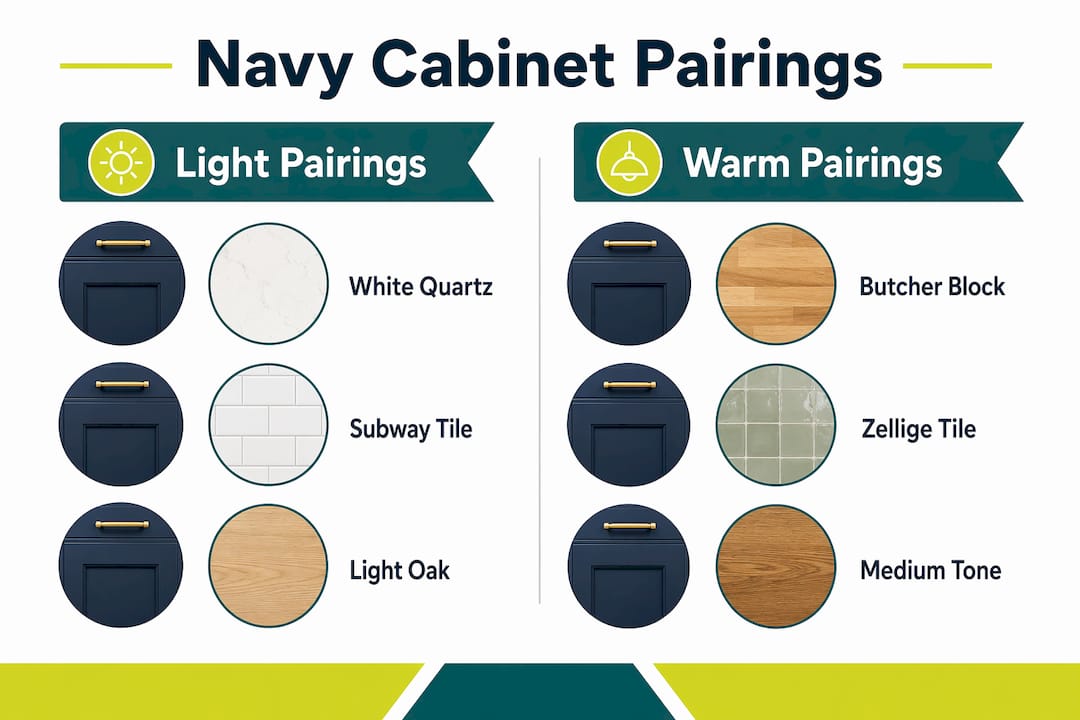
Warm-natural: Navy with warm butcher block or white oak countertops, a zellige or handmade tile backsplash, and medium-tone wood flooring. This palette reads inviting rather than formal. Brass or satin-brass hardware is essential here; without metallic warmth, the pairing can read flat or dated.
Moody monochrome: Navy with dark soapstone or honed black granite, a matte black backsplash tile, and dark hardwood floors. This works in larger rooms with strong ambient lighting. The depth-on-depth contrast reads luxurious, but it requires a serious lighting plan to avoid a cave-like result.
Textured/patterned accents: Navy with marble-look quartz, a patterned cement tile or zellige backsplash, and light floors. Pattern tile adds texture and personality but requires careful coordination. Keep the floor and countertop calm when the backsplash is busy.
For backsplash choices, white subway tile, marble slab, zellige, and patterned tile all balance navy effectively. The caution with pattern tile is scale: a large geometric pattern on a small backsplash area can compete with the navy rather than complement it.
Trim and wall color rules: Keep walls lighter than the cabinets. Warm whites (Benjamin Moore White Dove, Sherwin-Williams Alabaster) work well. Avoid cool grays on walls; they fight with navy and make the room feel cold rather than sophisticated. White trim is the safest choice and keeps the visual field clean around the cabinetry.
Which finishes, door styles, and hardware work best with navy?
Sheen level changes how navy reads in daily light. Matte finishes absorb light and make the color look deeper and more saturated, which suits modern flat-panel doors. Satin finishes offer a slight reflectivity that works well with traditional raised-panel or Shaker profiles. Semi-gloss is the most practical choice for high-traffic kitchens because it cleans easily, though it can show surface imperfections more readily on dark colors.
Door Style | Recommended Sheen | Hardware Metals |
Flat-panel (modern/contemporary) | Matte or satin | Matte black, brushed brass, polished nickel |
Shaker (transitional/farmhouse) | Satin | Satin brass, brushed nickel, matte black |
Raised-panel (traditional) | Satin or semi-gloss | Unlacquered brass, oil-rubbed bronze, polished nickel |
Glass-front (display) | Satin | Brushed brass, polished nickel |
Hardware metal pairing rules:
Brass or unlacquered brass: The most consistently elegant pairing with navy over the past decade. Warm metal cuts the cool depth of the paint and reads expensive at almost any price point. Check current hardware trends for Ottawa-specific options.
Matte black: Strong contrast, works best with flat-panel modern doors and light countertops.
Brushed or polished nickel: Clean and modern; pairs well with stainless appliances.
Avoid bright chrome: It reads dated against deep navy.
Aged bronze: Works in transitional and Craftsman-style Ottawa homes.
Flat-panel doors let the navy color be the star. Shaker doors create subtle shadow lines that add dimension under different lighting conditions, which is particularly useful in Ottawa kitchens where natural light shifts dramatically between seasons.
How do you keep an Ottawa navy kitchen from feeling dark or small?
Layered lighting is non-negotiable with dark cabinetry. Navy absorbs light and can visually shrink a room without proper illumination. The fix is a three-layer system.
Layered lighting checklist:
Ambient lighting: Recessed ceiling fixtures or a central pendant provide overall room illumination. Aim for warm-to-neutral color temperatures (2700K–3000K) to complement navy’s cool undertones without making the room feel clinical.
Task lighting: Under-cabinet LED strips are the single most important addition for a navy kitchen. They eliminate dark shadows on countertops and make the work surface functional. Warm white LEDs (2700K–3000K) prevent the navy from reading too cold.
Accent lighting: Pendant lights over an island or peninsula add visual interest and define zones. Two or three pendants spaced 30–40 inches apart, hung 30–36 inches above the countertop, is the standard for most Ottawa island configurations.
Natural light: Keep window treatments minimal. Light-colored blinds or sheer panels maximize daylight, which is especially valuable during Ottawa’s shorter winter days.
Layout red flags to avoid:
Dark floors combined with full navy cabinetry in a small kitchen. Two deep tones in a tight space crowd the eye.
No under-cabinet task lighting. This is the single most common mistake in navy kitchen installations.
Cool gray walls paired with cool-undertone navy. The combination reads cold and flat rather than sophisticated.
Reflective surfaces help significantly. A glossy or polished backsplash tile bounces light back into the room. Integrated or panel-ready appliances in light finishes keep the perimeter from adding more visual weight. Mirrored or glass cabinet inserts on upper doors also return light into the space.
What paint systems and maintenance routines keep navy looking rich?
Cabinet-grade finishes outperform standard wall paint on cabinetry, and the difference shows most on dark colors. For navy specifically, three systems are worth knowing.
Acrylic enamel is the most accessible option and performs well when applied by a professional spray system. It offers good hardness and cleanability. Conversion varnish and two-component lacquer are the professional-grade choices: harder, more chemical-resistant, and more durable under the daily wear of a Canadian kitchen. Factory-style spray application produces a smoother, more even finish than brush or roller application, and on a deep color like navy, any texture variation is visible.
Finish sheen is a practical decision, not just an aesthetic one. Matte looks rich but shows grease marks more readily. Satin is the most practical balance for Ottawa kitchens: it cleans easily, holds up to humidity fluctuations, and doesn’t amplify surface imperfections the way semi-gloss can on dark colors.
Daily maintenance checklist:
Wipe cabinet faces with a damp microfiber cloth after cooking. Grease and steam are the primary enemies of any dark finish.
For grease spots, use a mild dish soap solution and rinse immediately. Avoid abrasive pads or scouring powders.
Touch up minor chips with a small artist’s brush and the original paint color. Keep a small labeled jar of the exact color for this purpose.
In Ottawa’s humid summers, keep kitchen ventilation running during and after cooking to reduce moisture buildup on cabinet surfaces.
The DIY vs. professional decision comes down to finish quality. A brush-applied DIY finish on navy will show brush marks and uneven coverage more than the same color applied by a professional spray system. For a color this deep, the spray application is worth the investment.
What does cabinet refinishing vs. replacement cost in Ottawa?
Refinishing existing cabinets in navy is the most cost-effective path for most Ottawa homeowners. Full cabinet replacement in Canada typically runs significantly higher than a professional refinish, and for kitchens where the box structure and layout are sound, replacement rarely makes financial sense.
Typical Ottawa cost ranges (CAD):
Professional cabinet refinishing (spray finish, full kitchen): generally $2,000–$5,000 depending on door count, condition, and finish complexity.
Full cabinet replacement: typically $10,000–$30,000+ depending on material, layout changes, and installation.
DIY refinishing (materials only): $300–$800, but results vary significantly without professional spray equipment.
Timeline bullets for a professional Ottawa refinish:
Day 1–2: Prep work. Doors removed, hardware off, surfaces cleaned, sanded, and primed.
Day 3–5: Spray application of cabinet-grade finish in navy. Multiple coats with light sanding between.
Day 6–8: Cure time. Ottawa’s humidity levels in summer can extend cure time slightly; winter projects in heated spaces typically cure faster.
Day 9–10: Reassembly, hardware installation, final inspection.
Refinish vs. replace decision checklist:
Refinish if: Cabinet boxes are structurally sound, layout works for your needs, you want to change color without disrupting the kitchen.
Replace if: Boxes are damaged or warped, you need a layout change, or hardware mounting points are compromised.
Consider refinish first: A professional spray finish on existing cabinets can produce a result that is visually indistinguishable from new cabinetry at a fraction of the cost.
Ottawa navy kitchen inspiration: real examples that work
These five pairings illustrate how navy succeeds across different kitchen types. Each one works because of specific decisions, not just the color itself.
Navy island, white quartz, warm oak floor: The island becomes the room’s anchor. White quartz keeps the countertop bright, and warm oak flooring prevents the navy from reading too cold. Brass cabinet pulls tie the warm floor to the cool island.
Full navy run, light marble-look quartz, white subway tile: A classic formal kitchen. The light countertop and backsplash return enough light to keep the room from feeling heavy. Polished nickel hardware keeps the palette crisp.
Navy lowers, cream uppers, butcher block: A farmhouse-leaning kitchen that works well in older Ottawa homes. The cream uppers soften the contrast, and butcher block adds warmth. This is a strong choice for modern farmhouse cabinet styles.
Navy island, dark soapstone, brass hardware: A moody, high-contrast combination for a larger kitchen with strong lighting. The depth-on-depth approach reads luxurious when the ambient and task lighting are well-planned.
Navy accent wall of cabinets, glass fronts, white perimeter: A partial navy application that works in smaller Ottawa kitchens. Glass-front doors on the navy section display dishes against the dark background, making the color feel intentional rather than heavy.
When reviewing inspiration photos, focus on three things: the quality of light in the image, the countertop contrast ratio, and the hardware finish. Those three elements determine whether the navy reads as sophisticated or flat.
How Ottawa pros prep and paint navy cabinets
Professional cabinet painting in Ottawa follows a specific process that DIY approaches rarely replicate fully. The prep work is where the result is determined.
Standard Ottawa refinish process:
Day 1: Full kitchen assessment. Doors and hardware removed. Cabinet boxes masked and protected in place.
Day 2: Cleaning with a degreaser, light sanding of all surfaces, and application of a shellac-based or adhesion primer. This step is critical for dark colors; skipping it is a recipe for peeling.
Day 3–5: Spray application of cabinet-grade acrylic enamel or conversion varnish in the chosen navy. Two to three coats with light sanding between each.
Day 6–8: Cure period. Doors remain off to allow full hardening without contact marks.
Day 9–10: Reassembly, hardware installation, and final walk-through with the homeowner.
Ottawa climate note: High summer humidity (July and August) can extend cure times by 12–24 hours. Scheduling a navy refinish in spring or fall typically produces the most consistent results.
Project Phase | Duration | Homeowner Impact |
Prep and prime | 1–2 days | Kitchen accessible; doors off |
Spray application | 2–3 days | Minimal kitchen use; ventilation required |
Cure period | 2–3 days | Doors off; cabinets usable with care |
Reassembly | 1 day | Full kitchen restored |
Total | ~10 days | Minimal disruption |
What to ask a pro before hiring:
What paint system do you use, and is it cabinet-grade?
Do you spray on-site or off-site?
What is your prep process, specifically for degreasing and priming?
What warranty do you offer on the finish?
Ottawacabinetpainting backs its work with a 6-year warranty, which reflects the quality of the paint system and application process. A shorter warranty from another provider is worth questioning.
Key Takeaways
Navy cabinets work in Ottawa kitchens when undertone, light strategy, and complementary surfaces are chosen together rather than in isolation.
Point | Details |
Undertone sampling is mandatory | Test a large painted board in your Ottawa kitchen at morning, noon, and evening before committing to a navy shade. |
Balance with light surfaces | White quartz, marble-look countertops, or light oak floors return the light that navy absorbs. |
Layered lighting prevents dark results | Under-cabinet LEDs at 2700K–3000K are the single most important addition for any navy kitchen. |
Refinishing beats replacement for most Ottawa homes | Professional spray refinishing typically costs $2,000–$5,000 CAD versus $10,000–$30,000+ for full replacement. |
Ottawacabinetpainting offers a local pro path | A 10-day refinish process with a 6-year warranty delivers a factory-quality navy finish without full cabinet replacement. |
The part most homeowners get wrong about navy cabinets
Navy is one of the most forgiving cabinet colors available, but it exposes poor planning faster than almost any other choice. The homeowners who end up unhappy with navy kitchens almost always made the same mistake: they chose the color first and figured out the lighting and surfaces afterward.
Color is the last decision, not the first. Before you commit to a navy shade, map out your light sources, decide on your countertop material, and pick your hardware finish. Then test the navy. A cool-undertone navy that looked perfect on a paint chip can read gray and flat in an Ottawa kitchen with north-facing windows and LED recessed lights. A warm-undertone navy in the same room reads rich and intentional.
The other underestimated factor is the ceiling height. Navy in a kitchen with 8-foot ceilings and limited windows requires a more aggressive lighting plan than the same color in a 10-foot-ceiling space. If you are working with a standard Ottawa bungalow or a lower-ceiling condo kitchen, the lighting plan matters more than the specific navy shade you choose.
The good news is that a professional spray finish in navy, done properly with the right primer and cabinet-grade paint, is one of the most durable finishes you can put on a kitchen cabinet. It hides minor scratches and fingerprints better than lighter colors, and it ages well. Get the prep and the lighting right, and navy will look as good in ten years as it does on installation day.
Ottawacabinetpainting turns existing cabinets into a navy showpiece
Replacing cabinets to get a navy kitchen is the expensive route. Ottawacabinetpainting refinishes your existing cabinet boxes with a professional spray system and cabinet-grade finish, delivering a factory-smooth navy result in roughly 10 days. The process includes full degreasing, shellac-based priming, and multiple spray coats, with a 6-year warranty on the finished work. You keep your layout, your boxes, and your budget. For Ottawa homeowners who want the depth and sophistication of navy without the disruption of a full renovation, this is the practical path. View cabinet painting services or browse before-and-after results to see what a professional spray finish looks like on real Ottawa kitchens. Request a free quote and get a clear timeline and price for your specific kitchen.
Useful sources for Ottawa homeowners researching navy cabinets
Floors & Kitchen Today — Kitchen Cabinet Color Psychology: Research-backed overview of how dark cabinet colors affect mood, eating habits, and kitchen atmosphere. Useful for understanding why navy works beyond aesthetics.
D and G Flooring — Navy Blue Kitchen Island Guide: Detailed guide covering navy shade selection, countertop pairings, hardware, and lighting for island applications. Practical for Ottawa homeowners considering a partial navy approach.
YOLO Deco — Navy Blue Kitchen Cabinets: Covers undertone behavior under different lighting conditions and sampling advice. Directly relevant to Ottawa’s varied natural light conditions.
American Tin Ceilings — What Goes with Blue Cabinets: Backsplash pairing recommendations and cautions for pattern tile. Useful for building a complete navy palette.
Precision Concrete Coating — Durable Home Surfaces: Guidance on countertop material durability for Canadian kitchens, including quartz and porcelain performance under heavy use.
Ottawacabinetpainting — Ottawa Cabinet Color Trends: Local perspective on which cabinet colors are trending in Ottawa homes and why navy continues to lead requests.
Recommended

Comments