What Is a Professional Paint Sprayer for Ottawa Homes
- Axcell Painting

- 1 day ago
- 8 min read
TL;DR:
HVLP sprayers provide Ottawa homeowners with a smooth, factory-like finish for cabinet refinishing projects. Proper preparation, matching the sprayer to the task, and correct technique are essential for professional results. Off-site spraying and careful setup lead to the best, dust-free, durable finishes.
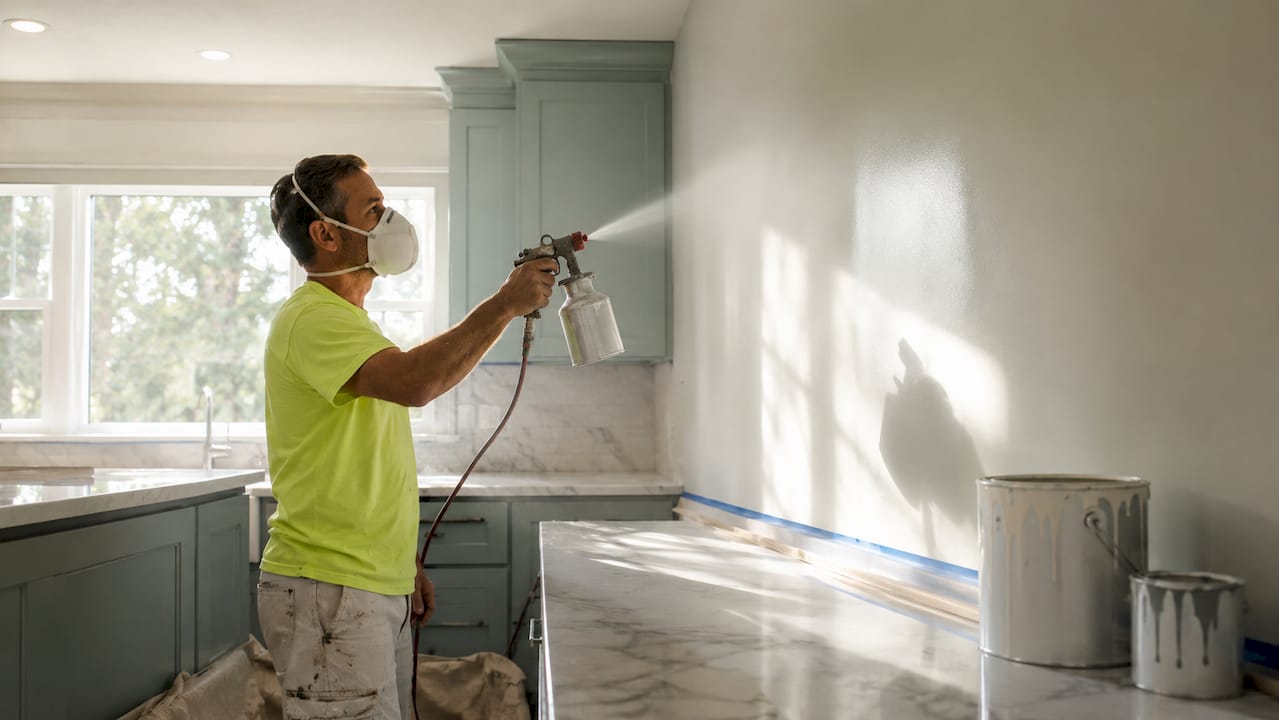
A professional paint sprayer is a precision tool that atomizes liquid paint into fine droplets and delivers them onto a surface in a controlled, uniform coat. For Ottawa homeowners tackling cabinet refinishing or larger renovation projects, understanding this tool is the difference between a factory-smooth finish and a frustrating mess. Brands like Graco and Fuji have built their reputations on professional spray painting equipment that outperforms brushes and rollers in both speed and finish quality. This guide breaks down the types, the selection criteria, and the techniques you need to get it right.
What is a professional paint sprayer and how does it work?
A professional paint sprayer works by forcing paint through a small tip at high velocity, breaking it into a fine mist that lands evenly on the surface. The key word is atomization: the finer the droplets, the smoother the final coat. This is exactly why professional sprayers produce results that brushes and rollers simply cannot match on cabinet doors, drawer fronts, and trim.
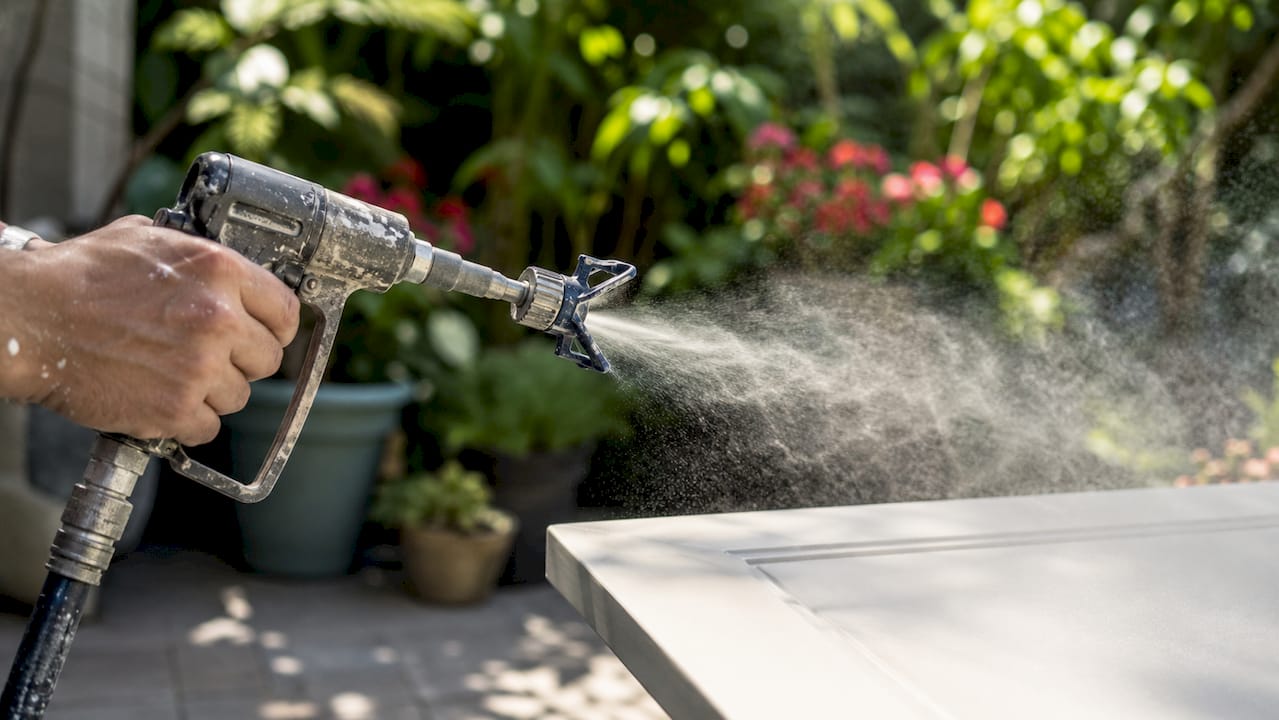
Three core technologies define the professional sprayer market. Airless sprayers use a hydraulic pump to push paint at very high pressure. HVLP (High Volume Low Pressure) sprayers use a turbine or compressor to deliver paint at low pressure with fine atomization. HEA (High Efficiency Airless) sprayers are a newer category that combines airless speed with better overspray control.
Each technology produces a different result. Pneumatic HVLP guns achieve 65–70% transfer efficiency with droplet sizes in the 20–50 micron range. That means more paint lands on your cabinet and less floats into the air. Airless sprayers, by contrast, operate at 40–50% transfer efficiency with larger droplets in the 70–150 micron range. Higher efficiency matters both for finish quality and for how much paint you waste.
Types of paint sprayers: which one fits your project?
Choosing the right sprayer type is the single most important decision you will make before starting a cabinet project. The wrong tool produces orange peel texture, runs, or wasted paint. The right tool produces a finish that looks like it came out of a factory.
Sprayer Type | Pressure | Droplet Size | Transfer Efficiency | Best For |
Airless | Very high | 70–150 µm | 40–50% | Large exterior surfaces, fences |
HVLP Pneumatic | Low | 20–50 µm | 65–70% | Cabinets, furniture, trim |
HEA Airless | Moderate | Medium | Up to 55% less overspray than airless | Large home renovation projects |
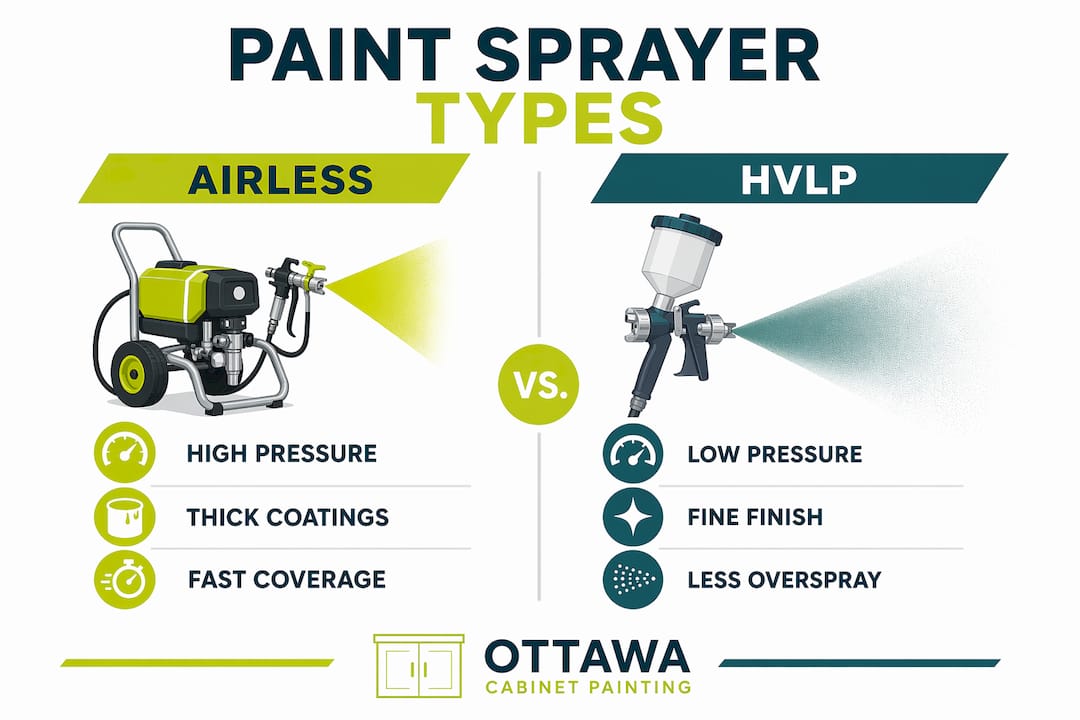
Airless sprayers like the Graco 390 are production tools. They move paint fast and handle thick coatings without thinning. The Graco 390 ranges from $800 to $3,000 depending on configuration. That speed comes with a trade-off: airless sprayers are designed for speed but produce more overspray, which makes them less ideal for detailed cabinet work indoors.
HVLP systems like the Fuji Q5 turbine ($400–$900) are precision tools. The low pressure means less bounce-back, less overspray, and a finer finish on detailed surfaces. For cabinet doors and drawer fronts, HVLP is the preferred choice among professional finishers.
HEA technology, developed by Wagner SprayTech, reduces overspray by up to 55% compared to traditional airless sprayers. That reduction makes HEA sprayers a strong option for Ottawa homeowners who want airless speed with better control on larger interior projects.
Pro Tip: An undersized air compressor paired with an HVLP gun causes orange peel texture and uneven coverage. Match your compressor’s CFM rating to your gun’s requirements before you start.
How to choose the right sprayer for Ottawa cabinet projects
The right sprayer for cabinetry is not the most expensive model but the one matched to the job. Cabinet refinishing demands fine atomization, consistent pressure, and a finish free of texture. That profile points directly to HVLP for most Ottawa homeowners.
Here are the key factors to weigh before buying or renting:
Atomization quality. Cabinet surfaces show every flaw. HVLP systems produce the fine droplets needed for a glass-smooth finish. Airless sprayers are better suited to exterior siding and fences.
Upfront cost vs. long-term value. Professional-grade sprayers cost between $400 and $3,000, while manual tools cost under $40. If you plan to refinish cabinets once, renting a quality HVLP unit often makes more financial sense than buying.
Duty cycle. Duty cycle indicates how long a sprayer can run continuously without failure. Hobby-grade sprayers fail under the sustained use that a full kitchen cabinet project demands. Always check the duty cycle rating before committing to a unit.
Portability and setup space. Ottawa homes vary widely in kitchen size and layout. A turbine HVLP system is self-contained and easier to move than a compressor-fed setup.
Paint compatibility. Thicker paints like latex require larger tip sizes or thinning. Lacquers and waterborne alkyd paints flow more easily through HVLP systems without much adjustment.
For a deeper look at sprayer options for Ottawa cabinets, matching the tool to your specific paint and surface type is the starting point.
Pro Tip: Always test your sprayer settings on a piece of cardboard before touching your cabinet doors. Adjust pressure and fan width until you get a smooth, even oval pattern with no heavy edges.
How to use a professional paint sprayer for flawless cabinet finishes
Successful professional spraying is 80% preparation and 20% execution. That ratio surprises most homeowners who assume the sprayer does the work. The prep work is where the finish is actually won or lost.
Prepare the environment. Remove cabinet doors and hardware. Work in a clean, dust-free space. Lay drop cloths and mask off anything you are not painting. Dust and debris embed into wet paint and ruin the finish.
Prep the surface. Sand cabinet surfaces with 150-grit sandpaper, then wipe clean with a tack cloth. Apply a shellac-based primer for the best adhesion, especially on previously painted or stained wood. Let it dry fully before sanding again with 220-grit.
Calibrate your sprayer. Adjust pressure, tip size, and fan pattern for your specific paint. Professional spraying requires precise control rather than just pulling the trigger. A wide fan pattern works for flat cabinet faces. A narrower pattern suits edges and stiles.
Apply with consistent technique. Hold the gun 8–12 inches from the surface. Move at a steady, even pace. Overlap each pass by 50% to avoid streaks. Start and stop your trigger motion off the edge of the panel, not on it.
Apply multiple thin coats. One thick coat causes runs and sags. Two or three thin coats build a durable, smooth finish. Sand lightly between coats with 320-grit for the best result.
Clean your sprayer immediately after use. Flush the system with the appropriate solvent while the paint is still wet. Dried paint in the tip or fluid passages is the most common cause of sprayer failure. For a complete guide on kitchen cabinet spraying techniques, proper cleanup extends the life of your equipment significantly.
Sprayer vs. brush and roller: pros and cons for Ottawa homeowners
Sprayers are not always the right answer. The choice depends on your project type, your home’s occupancy, and how much prep work you are willing to do.
Advantages of professional paint sprayers:
Produce a smooth, factory-like finish on cabinets that brushes and rollers cannot replicate
Cover large surfaces like exterior siding or fences significantly faster
Reach recessed panel details and inside corners without brush marks
Deliver uniform color and sheen across every surface
Disadvantages to consider:
Require extensive masking and prep to protect surrounding surfaces from overspray
Professionals often prefer brush and roller for occupied interiors to avoid the disruption and contamination risk that spraying creates
Carry a learning curve: poor technique produces runs, orange peel, or uneven coverage
Equipment cost and maintenance add to the overall project budget
For Ottawa homeowners painting walls in an occupied home, a roller is often the practical choice. For cabinet refinishing, a sprayer is the right tool. The key is knowing which situation calls for which method. You can also review how to pick cabinet paint to make sure your paint choice works with your sprayer setup.
Key Takeaways
A professional paint sprayer delivers a factory-smooth finish through controlled atomization, and HVLP systems are the best choice for Ottawa cabinet refinishing projects.
Point | Details |
HVLP is best for cabinets | HVLP sprayers achieve 65–70% transfer efficiency with fine droplets ideal for smooth cabinet finishes. |
Prep determines finish quality | Preparation accounts for 80% of the final result; surface and environment prep cannot be skipped. |
Match the tool to the job | The right sprayer is not the most expensive but the one suited to your paint type and surface. |
Duty cycle matters | Always check duty cycle ratings before using a sprayer on a full kitchen cabinet project. |
Spraying indoors requires caution | Occupied homes need extensive masking; off-site cabinet spraying produces the cleanest results. |
What we have learned from spraying Ottawa cabinets
After working on cabinet refinishing projects across Ottawa, the single biggest mistake we see homeowners make is treating a paint sprayer like a shortcut. It is not. A sprayer is a precision instrument that rewards careful setup and punishes rushed prep work.
The detail that surprises most people: the best cabinet finishes we produce are done off-site. We remove the doors, bring them to a controlled environment, and spray them away from the dust, humidity, and foot traffic of a working kitchen. Professionals spray cabinets off-site in a controlled environment to avoid contamination and achieve that factory-like result. Trying to spray cabinet doors in your kitchen while the family is home is a recipe for dust nibs, overspray on your appliances, and a finish you will not be happy with.
We have also seen homeowners buy the most expensive airless sprayer they could find, then use it on cabinet doors and wonder why the finish looks rough. Airless sprayers are production tools built for large exterior surfaces and thicker coats. They are not the right tool for fine cabinet work. An HVLP system at a fraction of the price will outperform an airless sprayer on cabinetry every single time. Matching the equipment to the project is the decision that separates a great finish from a frustrating one.
— Ottawa
Cabinet spraying services from Ottawacabinetpainting
If you have read this far and realized that getting a truly smooth cabinet finish requires more equipment, prep, and technique than you expected, you are not alone. That is exactly why Ottawacabinetpainting exists. We specialize in professional cabinet painting for Ottawa homeowners who want a high-end result without replacing their cabinets entirely. Our process includes off-site spraying, shellac-based priming, and a 6-year warranty on every project. If you want to see what is possible, browse our before and after results or request a free spray painting quote to get started.
FAQ
What is the best type of paint sprayer for kitchen cabinets?
HVLP sprayers are the best choice for kitchen cabinets. They deliver fine atomization with 65–70% transfer efficiency, producing a smooth finish with minimal overspray.
How much does a professional paint sprayer cost?
Professional-grade sprayers range from $400 to $3,000 depending on type. Fuji HVLP turbine systems start around $400, while Graco airless models can reach $3,000.
Can I use a paint sprayer indoors on my Ottawa cabinets?
Spraying indoors in an occupied home requires extensive masking and creates overspray risk. Most professionals remove cabinet doors and spray them off-site for the cleanest result.
How do I avoid runs and drips when spraying cabinets?
Apply multiple thin coats rather than one heavy coat. Hold the gun 8–12 inches from the surface and keep a steady, even pace across each panel.
Does a more expensive sprayer always produce a better finish?
No. The right sprayer for the task matters more than price. An HVLP system suited to cabinetry will outperform a high-cost airless sprayer on fine finish work every time.
Recommended
Comments