Environmental Impact of Refinishing: Ottawa Homeowner's Guide


TL;DR:
Refinishing reduces carbon emissions by up to 89 percent compared to replacing surfaces entirely.
Choosing local contractors and proper waste disposal methods enhances its environmental benefits.
Refinishing is defined as the process of restoring an existing surface, whether cabinetry, furniture, or flooring, by sanding, recoating, or repainting rather than replacing it entirely. The environmental impact of refinishing is substantially lower than replacement because it conserves raw materials, reduces landfill waste, and cuts carbon emissions at every stage of the product lifecycle. Research from Bona and the IVL Swedish Environmental Research Institute confirms that refinishing reduces CO2 emissions by 83%–89% compared to full replacement. For Ottawa homeowners weighing a kitchen cabinet overhaul or floor renewal, that number changes the entire conversation about what “sustainable renovation” actually means.
How does refinishing in Ottawa reduce carbon emissions compared to replacement?
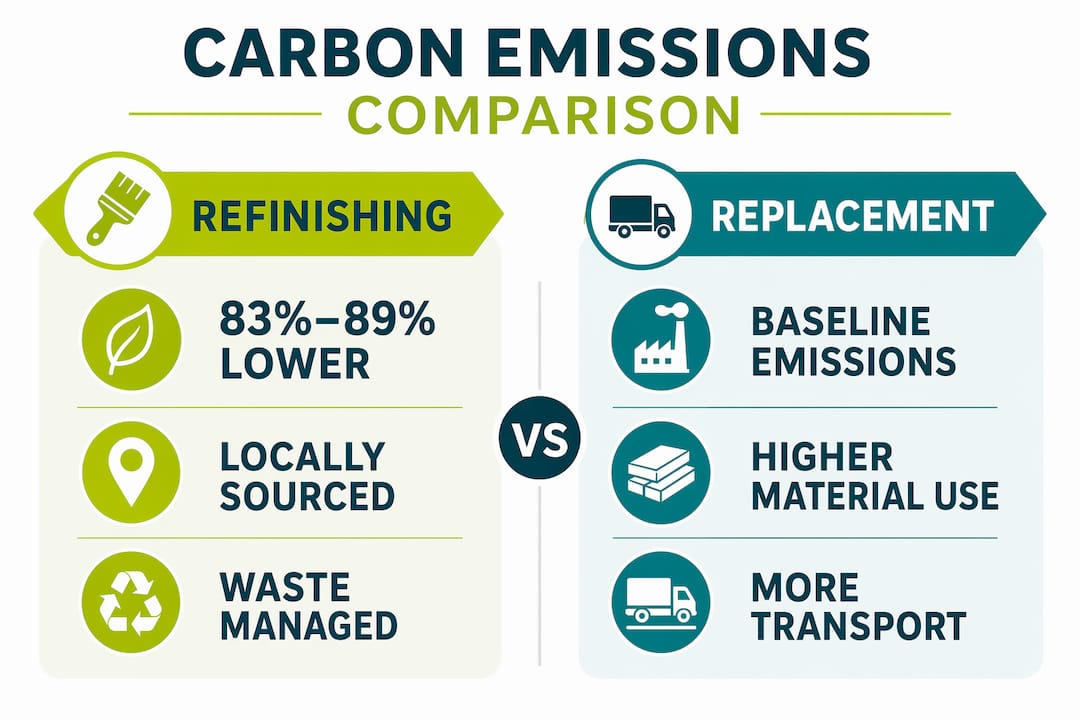
Refinishing beats replacement on carbon savings by a wide margin. The IVL Swedish Environmental Research Institute, working with Bona, conducted a full life cycle assessment comparing floor refinishing against new floor installation. The 83%–89% CO2 reduction comes primarily from avoiding the energy-intensive manufacturing of new materials. That is not a rounding error. It is the difference between a renovation that helps the planet and one that quietly harms it.
The environmental footprint of refinishing itself is real, though manageable. Bona’s 2025 quantitative life cycle analysis identifies three main contributors: finishing product production, transport, and electricity used during sanding. Each of these can be reduced with deliberate choices. Sanding efficiency, local sourcing of materials, and choosing a nearby contractor all move the needle.
Transport distance is a bigger variable than most homeowners expect. The IVL sensitivity analysis found that transport distance affects emissions more than the local electricity grid mix during sanding. Hiring a local Ottawa contractor rather than a distant service provider is not just convenient. It is a measurable environmental decision.
Factor | Refinishing | Full Replacement |
CO2 emissions | 83%–89% lower | Baseline (highest) |
Raw material use | Minimal (coatings only) | Full manufacturing cycle |
Landfill waste | Near zero | Significant (old materials) |
Transport impact | Low with local contractor | High (product shipping) |
Energy use | Sanding electricity only | Factory + shipping energy |
Pro Tip: When getting quotes in Ottawa, ask contractors where their finishing products are sourced. Locally sourced, low-VOC coatings cut both transport emissions and indoor air quality concerns at the same time.
What Ottawa homeowners need to know about refinishing waste disposal
Refinishing waste disposal is not as simple as bagging up dust and setting it at the curb. Older Ottawa homes built before 1978 may contain lead-based paint, and the EPA’s Renovation, Repair, and Painting (RRP) regulations are clear: lead renovation waste must be contained during collection and transport to prevent environmental releases. Waste that tests above 5 mg/L lead is classified as hazardous. That classification carries real legal and environmental consequences.
Improper disposal of lead-containing debris contaminates soil and groundwater. It also exposes homeowners to fines under Ontario environmental regulations. The good news is that Ottawa has accessible options. Ontario’s Household Hazardous Waste depots accept paint-related renovation waste, and the City of Ottawa operates Community Resource Centres (CRCs) where homeowners can drop off hazardous materials at no charge.
Here is what responsible refinishing waste disposal looks like in practice:
Contain dust at the source. Use plastic sheeting and tape to seal work areas before sanding begins, especially in homes with older paint layers.
Bag debris in sealed, labeled containers. Lead-containing dust and paint chips require double-bagging and clear hazard labeling before transport.
Never put refinishing chemicals in regular trash. Solvents, strippers, and old finish products are classified as hazardous waste under Ontario law.
Use Ottawa’s HHW drop-off depots. The City of Ottawa schedules seasonal Household Hazardous Waste collection events and maintains permanent CRC locations.
Hire licensed contractors for older homes. A certified RRP contractor knows the containment and disposal requirements and carries the liability if something goes wrong.
Pro Tip: Before any refinishing project in an Ottawa home built before 1980, test for lead paint using a certified lead test kit available at most hardware stores. The test costs under $15 and can save you from significant legal and health exposure.
How does refinishing support broader sustainability goals in Ottawa homes?
The sustainability of refinishing goes well beyond the carbon math. Extending the service life of existing cabinetry or flooring reduces the demand for virgin materials like hardwood, steel hardware, and petroleum-based composites. Every year a set of kitchen cabinets stays in service is a year that new manufacturing does not happen. That is the core logic behind what researchers call the avoided emissions credit framework.
A 2026 peer-reviewed study in the International Journal of Life Cycle Assessment found that avoided emissions credits from reuse can be allocated to both the original product user and the second-life user. This matters because conventional life cycle assessments often undercount the full environmental benefit of refinishing. The real savings compound over time when homeowners maintain refinished surfaces properly.
“Homeowners should view refinishing as a lifecycle strategy, not a one-time fix. The environmental advantages multiply each time a surface is maintained and extended rather than discarded.” — International Journal of Life Cycle Assessment, 2026
The broader sustainability case for refinishing in Ottawa also includes economic and social dimensions:
Reduced manufacturing demand. Keeping existing cabinets in service means fewer trees harvested, less factory energy consumed, and less packaging waste generated.
Lower renovation disruption. A full kitchen replacement generates construction debris, packaging waste, and old cabinet landfill. Refinishing produces a fraction of that waste stream.
Extended product lifespan. Properly maintained refinished surfaces can last decades. That longevity is the single biggest driver of environmental benefit, according to Bona’s 2025 life cycle findings.
Support for local economy. Choosing Ottawa-based refinishing services keeps spending local and reduces the supply chain footprint tied to imported cabinetry.
Ottawa homeowners who choose refinishing over replacement are making a decision that pays environmental dividends for years, not just on the day the project ends.
What practical steps maximize eco-friendly refinishing in Ottawa?
Eco-friendly refinishing does not happen by accident. It requires deliberate choices at every stage, from contractor selection to post-project maintenance. The good news is that most of these steps cost nothing extra and some actually save money.

The local service advantage is the most underrated factor. Transport emissions from bringing in contractors or materials from outside Ottawa add up quickly. The IVL study confirmed that transport distance influences the overall carbon footprint of a refinishing project more than the electricity source powering the sanding equipment. Staying local is one of the highest-impact choices you can make.
Here is a practical checklist for Ottawa homeowners planning a refinishing project:
Choose a local Ottawa contractor. Shorter travel distances directly reduce transport-related emissions tied to the project.
Request low-VOC or zero-VOC finishing products. Volatile organic compounds (VOCs) contribute to indoor air pollution and outdoor smog. Low-VOC waterborne finishes are now widely available and perform as well as traditional solvent-based products.
Ask about sanding efficiency. Orbital sanders with dust collection systems use less electricity and capture debris more effectively than older equipment.
Schedule waste drop-off before the project starts. Contact Ottawa’s CRC or HHW depot to confirm accepted materials and drop-off hours so you are not scrambling at the end.
Maintain the finish after completion. Regular cleaning with pH-neutral products and prompt repair of chips or scratches extends the surface life significantly. A longer-lasting finish means the environmental investment compounds over time.
Understand the cabinet refinishing benefits before committing. Knowing what you are getting helps you plan the project for maximum durability and minimum waste.
The refinishing chemical emissions question comes up often. Waterborne finishes have largely replaced solvent-based products in professional refinishing, and the difference in VOC output is significant. A professional Ottawa contractor using waterborne coatings will produce far lower chemical emissions than a DIY project using off-the-shelf solvent finishes.
Key Takeaways
Refinishing reduces CO2 emissions by 83%–89% compared to full replacement, making it the most effective sustainable choice for Ottawa homeowners renovating cabinetry or flooring.
Point | Details |
Carbon savings are dramatic | Refinishing cuts CO2 by 83%–89% versus replacement, per IVL and Bona research. |
Transport distance matters | Hiring a local Ottawa contractor reduces emissions more than switching electricity sources. |
Waste disposal requires care | Lead-containing debris from older homes must go to Ottawa’s HHW depots, not curbside trash. |
Service life drives the benefit | The longer a refinished surface lasts, the greater the environmental return on the project. |
Low-VOC products reduce chemical emissions | Waterborne, low-VOC finishes cut indoor air pollution and outdoor smog contributions significantly. |
What we have learned from years of refinishing Ottawa kitchens
After working on hundreds of Ottawa kitchens, we have seen a consistent pattern: homeowners who think about refinishing as a one-time cosmetic fix get good results. Homeowners who treat it as a long-term surface management strategy get exceptional results, and they get them for far longer.
The environmental conversation around refinishing is often oversimplified. People hear “refinishing is greener” and assume the job is done. What the 2026 International Journal of Life Cycle Assessment research makes clear is that the full environmental benefit only materializes when the refinished surface is maintained and extended over time. A refinished cabinet that chips and gets replaced in three years delivers far less environmental value than one that lasts fifteen.
We also see homeowners underestimate the waste disposal side of the equation. In Ottawa’s older housing stock, lead paint is not a rare edge case. It is common. Treating that waste carelessly undermines every carbon saving the refinishing project achieved. Responsible disposal is not optional. It is part of what makes the project genuinely sustainable.
The most overlooked factor? Choosing a contractor who sources finishing products locally and uses waterborne coatings. That single decision affects VOC emissions, transport footprint, and indoor air quality all at once. We use waterborne, low-VOC finishes on every project because the results are better for the home and better for Ottawa.
— Ottawa
Professional refinishing services that align with your sustainability goals
Ottawacabinetpainting offers professional cabinet and furniture refinishing built around quality materials, meticulous prep work, and a process designed to last. If you are an Ottawa homeowner who wants the environmental and financial benefits of refinishing without cutting corners on results, our team is the right fit. We use low-VOC waterborne finishes, work with local suppliers, and back every project with a 6-year warranty. Explore our interior refinishing services to see what a properly done refinishing project looks like, or get a free quote through our cabinet painting page. Your cabinets can look factory-finished and last for decades. That is the point.
FAQ
How much does refinishing reduce carbon emissions in Ottawa?
Refinishing reduces CO2 emissions by 83%–89% compared to full replacement, according to Bona’s 2025 IVL life cycle assessment. Choosing a local Ottawa contractor reduces the transport component of that footprint even further.
Is refinishing waste disposal regulated in Ontario?
Yes. Ontario classifies paint-related renovation waste and solvents as hazardous materials. Ottawa homeowners must use City of Ottawa Household Hazardous Waste depots or Community Resource Centres for proper disposal.
What are VOCs and why do they matter in refinishing?
VOCs, or volatile organic compounds, are chemicals released by solvent-based finishing products that contribute to indoor air pollution and outdoor smog. Low-VOC or waterborne finishes are the environmentally safe refinishing choice and are standard practice for professional Ottawa contractors.
Does refinishing older Ottawa homes require special precautions?
Yes. Homes built before 1980 often contain lead-based paint. The EPA’s RRP regulations require proper containment and licensed disposal of lead-containing debris to prevent environmental contamination and avoid regulatory fines.
How long does a refinished surface need to last to maximize environmental benefits?
The longer the better. Research from the International Journal of Life Cycle Assessment confirms that extending product service life is the primary driver of refinishing’s environmental advantage. A well-maintained refinished surface that lasts 15 or more years delivers the full carbon savings the process promises.
Recommended
Comments