What affects cabinet staining cost in Ottawa? Complete guide


TL;DR:
Cabinet staining in Ottawa costs $2,000–$6,000, offering a cost-effective alternative to replacement.
Proper prep work is essential, accounting for 75-80% of the project time and ensuring durability.
Staining enhances natural wood grain, while painting provides a more uniform color option.
Your kitchen doesn’t need a full gut renovation to look completely transformed. Cabinet staining is one of the most cost-effective upgrades Ottawa homeowners can make, yet most people either overprice it in their heads or underestimate what a skilled finish actually involves. The real numbers are far more accessible than you might expect. In this guide, we break down what cabinet staining typically costs in Ottawa, what drives prices up or down, how staining compares to painting, and exactly what your money is buying at every stage of the process.
Table of Contents
Key Takeaways
Point | Details |
Wide price range | Cabinet staining in Ottawa typically costs CA $2,000–$6,000 for most kitchens, depending on size and complexity. |
Major savings | You can save 60–80% over the price of full cabinet replacement when choosing professional staining. |
Prep is crucial | Most of the cost comes from detailed preparation and skilled labor, not just materials. |
Best for wood | Staining delivers the best results and value for solid wood cabinets, revealing the natural grain. |
ROI and durability | Expertly stained cabinets can last 10–15 years and boost your home’s value with proper care. |
How much does cabinet staining cost in Ottawa?
Let’s get to the numbers first, because that’s likely what brought you here. Cabinet staining in Ottawa falls within a wide price range depending on kitchen size, material type, and project scope, but there are solid benchmarks you can use to plan your budget.
Professional cabinet refinishing in Ottawa typically costs CA $2,000–$6,000 for small to mid-sized kitchens, with per-unit pricing around $40–$100 per cabinet door and $35–$80 per drawer. That means a kitchen with 20 doors and 10 drawers could land anywhere from $1,150 to $2,800 on unit pricing alone before factoring in labor, prep, and finish coats.
Here’s a broader look at how projects break down by scope:
Project tier | Typical cost range | Best suited for |
Basic refinishing | $1,500–$3,500 | Small kitchens, minimal prep needed |
Mid-range refinishing | $3,500–$6,500 | Average kitchens, solid wood, some repairs |
Comprehensive refinishing | $6,500–$10,000 | Large kitchens, dark stains, grain filling |
These refinishing costs explained become even more compelling when compared to full cabinet replacement, which runs $15,000–$50,000 for most Ottawa kitchens. Staining can save you 60–80% versus full replacement, which is a significant reason so many homeowners are choosing it over tearing everything out.
Here are the key cost factors at a glance:
Number of doors and drawers: The single biggest driver of your total price
Kitchen layout: More cabinets and corners mean more labor time
Wood condition: Repairs and filling add to prep time and cost
Stain color selected: Darker stains require more coats and more preparation
Topcoat choice: Polyurethane adds durability and cost
Hardware removal and reinstallation: Often billed separately or included depending on the contractor
For most Ottawa homeowners, a realistic staining budget sits in the $3,000–$5,500 range for a standard kitchen. That’s a fraction of what you’d spend replacing everything.
What factors influence your cabinet staining cost?
With base numbers in mind, let’s look at what can shift your project’s final cost up or down.
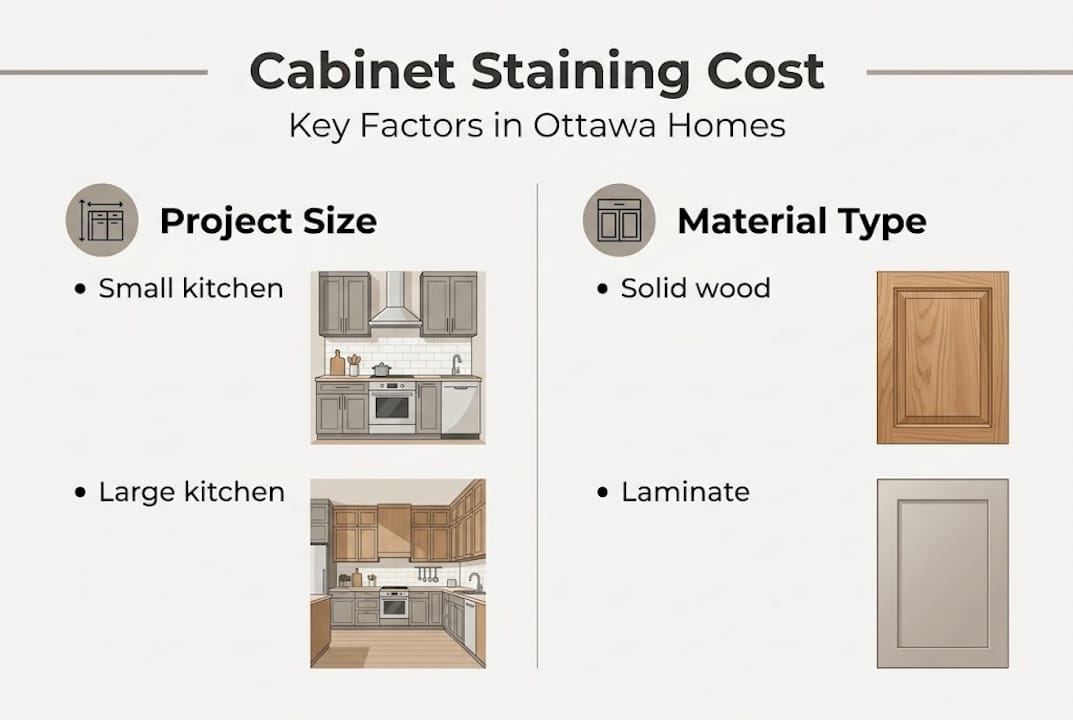
The size and layout of your kitchen play a direct role. A compact galley kitchen with 15 cabinet doors costs far less to stain than an open-concept L-shaped kitchen with 30 doors, deep upper cabinets, and a full island. Each additional unit adds labor time, material cost, and drying time between coats.

Wood species is another major variable. Solid wood is the only material that responds well to staining. Oak, maple, cherry, and walnut all take stain differently, and each requires a tailored approach. Painted vs stained transformation outcomes depend heavily on whether the wood has an open or closed grain. Oak, for example, has a very open grain, which means grain filling is often necessary before staining to achieve a smooth, professional result. That step adds both time and cost.
Laminate cabinets, on the other hand, cannot be stained effectively. Stain needs to penetrate wood fibers to develop color and adhere properly. If your cabinets are laminate or structurally damaged, kitchen cabinet remodel cost factors shift dramatically, and refacing or replacement may be more appropriate.
Dark stain colors are popular right now, and for good reason. They look stunning on solid wood. But achieving a deep, even dark stain requires significant prep work, including grain filling on open-grained woods, multiple thin coats, and precise sanding between layers. Heavy prep for dark stains and grain filling adds 10–20% to your total cost, which is worth factoring in early.
Additional cost variables include:
Surface repairs: Dents, cracks, and worn edges need to be filled and sanded before staining
Hardware changes: Swapping hinges or pulls while cabinets are off adds minimal cost but great visual impact
Number of coats: Richer colors and better durability mean more coats, more time
Access and masking: Tight spaces require extra care to protect countertops, walls, and appliances
Pro Tip: Don’t cut corners on prep to save money upfront. A well-prepped surface holds stain far longer and reduces the chance of peeling, blotching, or uneven color. Spending a little more now protects your investment for years.
Cabinet staining vs. painting: Cost and value comparison
Many homeowners debate painting vs. staining. Here’s how to make the best call for your space and budget.
Both options refresh your cabinets dramatically without the cost of replacement. But they serve different goals and suit different kitchens. Understanding the difference helps you make a confident, informed decision.
Feature | Staining | Painting |
Material cost | Lower (stain + sealer) | Moderate (primer + paint) |
Labor cost | Similar | Similar |
Longevity | 10–15+ years with maintenance | 7–12 years with care |
Maintenance | Reseal every 3–5 years | Touch-ups as needed |
Best for | Solid wood, natural grain look | Any wood, laminate-adjacent finishes |
Color range | Limited (natural tones) | Nearly unlimited |
Finish look | Showcases wood grain | Smooth, uniform color |
According to our painting vs staining guide, staining costs similar to painting in labor but typically uses cheaper materials, though it does require resealing every 3–5 years versus simple paint touch-ups. That resealing step is easy and inexpensive, but it’s worth factoring into your long-term budget.
When should you choose staining?
Your cabinets are solid wood in good structural condition
You love the look of natural wood grain and want to enhance it
You’re going for a warmer, more organic aesthetic
You want a finish that highlights the character of the wood itself
When should you choose painting?
Your wood has an inconsistent grain or color you’d prefer to hide
You want a bold or modern color outside the natural spectrum
Some cabinet surfaces aren’t ideal for stain penetration
You prefer a cleaner, more uniform look
For insight on which finish holds up best in Ottawa’s climate, our best finish for Ontario kitchens breakdown is worth reading before you decide. Both options offer strong ROI compared to replacement, but the best choice depends on your specific wood, your style, and your long-term maintenance preferences.
The cabinet staining process: What you pay for step by step
Knowing the pros and cons, let’s see exactly what goes into a cabinet staining job and where your money is spent.
Labor is the largest line item in any staining project, and that’s because the process is genuinely time-intensive. Here’s how a professional job unfolds:
Removal and labeling: Doors, drawers, and hardware are removed and carefully labeled so everything goes back exactly where it belongs
Deep cleaning: Surfaces are cleaned with a TSP (trisodium phosphate) degreaser to remove grease, grime, and residue that would prevent proper stain adhesion
Repair and filling: Dents, cracks, and imperfections are filled with wood filler and sanded smooth
Sanding: Progressive sanding from 80 to 220 grit opens the wood grain and creates the ideal surface for stain to penetrate evenly
Priming (if needed): A shellac-based primer like BIN may be applied to block stains or stabilize problem areas before color goes on
Stain application: Oil-based or gel stain is applied in thin, even coats, with careful wiping to control penetration depth and color consistency
Topcoat sealing: A polyurethane topcoat is applied to protect the stain and add durability
The staining process using TSP degreaser and polyurethane topcoat preserves the wood grain and produces results that last 10–15+ years when done correctly.
Prep work accounts for 75–80% of total project time, which is why experienced professionals charge what they do. Rushing prep is the most common reason DIY projects look flat or uneven within a few years. Spray application techniques give professional finishes a factory-like smoothness that brushes and rollers simply can’t replicate. Full curing takes 7–14 days, meaning the cabinets need time before they reach their full hardness and durability.
For cabinet refinishing tips that help you understand what a quality job looks like, reviewing what a proper process involves will help you ask the right questions when getting quotes. A professional job takes 3–10 business days for a small to medium kitchen, while a DIY approach typically stretches to 7–14 days or longer.
Pro Tip: If you want a result that holds up for a decade or more, hire a professional with a track record of spray-applied finishes. The quality gap between a rushed DIY job and a proper professional finish is significant, and the cost difference is smaller than most homeowners expect.
What most homeowners miss when budgeting for cabinet staining
Here’s the truth we see repeatedly: most Ottawa homeowners focus almost entirely on the stain color and overlook the prep work that actually determines whether a project succeeds or fails. Prep is where most of the labor hours go, and it’s where corners are most often cut.
We’ve seen kitchens where homeowners hired the cheapest bidder and ended up with blotchy, peeling results within two years. Then they paid again to have it redone properly. That’s not a savings strategy. That’s paying twice.
The honest reality is that good staining is a skilled trade. Grain filling, progressive sanding, thin coat application, and full curing are not optional steps. They’re what separate a finish that looks beautiful in five years from one that looks tired in two. And when you’re thinking about real kitchen results over the long term, a staining job done right can meaningfully improve your home’s resale appeal.
A rushed or cheaply executed project, on the other hand, can actually hurt your kitchen’s presentation to potential buyers. Budget for the process, not just the product.
Explore affordable Ottawa cabinet refinishing solutions
Ready to begin your own transformation? Here’s how to take the next step with confidence.
At Ottawa Cabinet Painting, we work with homeowners throughout Ottawa to deliver professional staining results that are tailored to your budget, your wood type, and your style preferences. Our team handles every stage of the process with care, from deep cleaning and prep to spray application and final sealing. You can see before-and-after results from real Ottawa kitchens to get a sense of what’s possible, and then get a free quote with transparent, itemized pricing. No surprises, no guesswork. Just a clear plan for getting your kitchen looking its best.
Frequently asked questions
Is staining cheaper than painting kitchen cabinets?
Staining costs similar to painting in labor but typically uses slightly less expensive materials. Over time, staining may cost more due to resealing every 3–5 years, while painted cabinets mainly need periodic touch-ups.
How long does cabinet staining last?
With proper maintenance, professionally stained cabinets last 10–15+ years. Regular resealing and gentle cleaning help maximize the lifespan of the finish.
Can all cabinet materials be stained?
Only solid wood cabinets are ideal candidates for staining. Laminate and structurally damaged cabinets do not absorb stain properly and typically require refacing or replacement instead.
How long does cabinet staining take in Ottawa?
For a small to medium kitchen, professional staining takes 3–10 business days. DIY projects often run 7–14 days or longer due to the learning curve and drying times between coats.
How much does it cost to stain cabinets per door in Ottawa?
In Ottawa, per-door pricing runs $40–$100 per cabinet door and $35–$80 per drawer, with total project costs varying based on kitchen size, wood type, and prep requirements.
Recommended
Comments