Why kitchens are the heart of every home
- Axcell Painting

- Apr 29
- 9 min read
TL;DR:
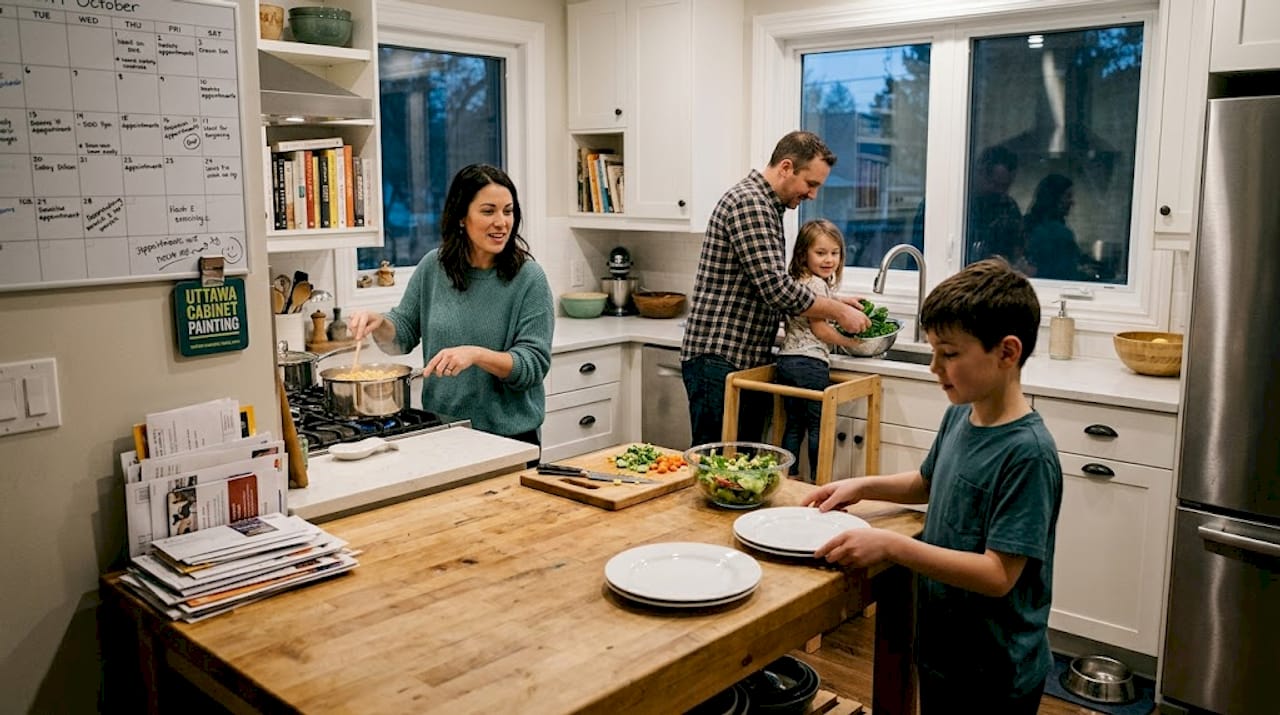
Kitchens have evolved from hidden utility spaces to central social hubs in homes.
Creating a warm, inviting kitchen environment fosters natural gatherings and emotional connection.
Refinishing cabinets preserves character and offers affordable, functional updates over full replacements.
For most of history, kitchens were deliberately hidden from guests, tucked away at the back of the house like a well-kept secret. Today, that’s completely reversed. The kitchen is now the heart of the home, evolving from a purely utilitarian work zone into the central social hub where families connect, guests linger, and memories are built. For Ottawa homeowners, this shift carries a very practical implication: the condition of your kitchen, especially its cabinets, shapes how welcoming and functional that gathering space feels. Understanding why kitchens hold this role, and how you can affordably enhance yours, is exactly what we’ll cover here.
Table of Contents
Key Takeaways
Point | Details |
Kitchen evolution | Kitchens have evolved from functional spaces to the emotional and social center of the home. |
Affordable transformation | Cabinet refinishing helps Ottawa homeowners upgrade kitchens affordably while preserving character. |
Layout matters | Choosing the right kitchen layout improves both social flow and daily use. |
Preserve memories | Keeping existing cabinets retains your kitchen’s unique history and welcoming feel. |
The kitchen’s transformation: from utility to gathering space
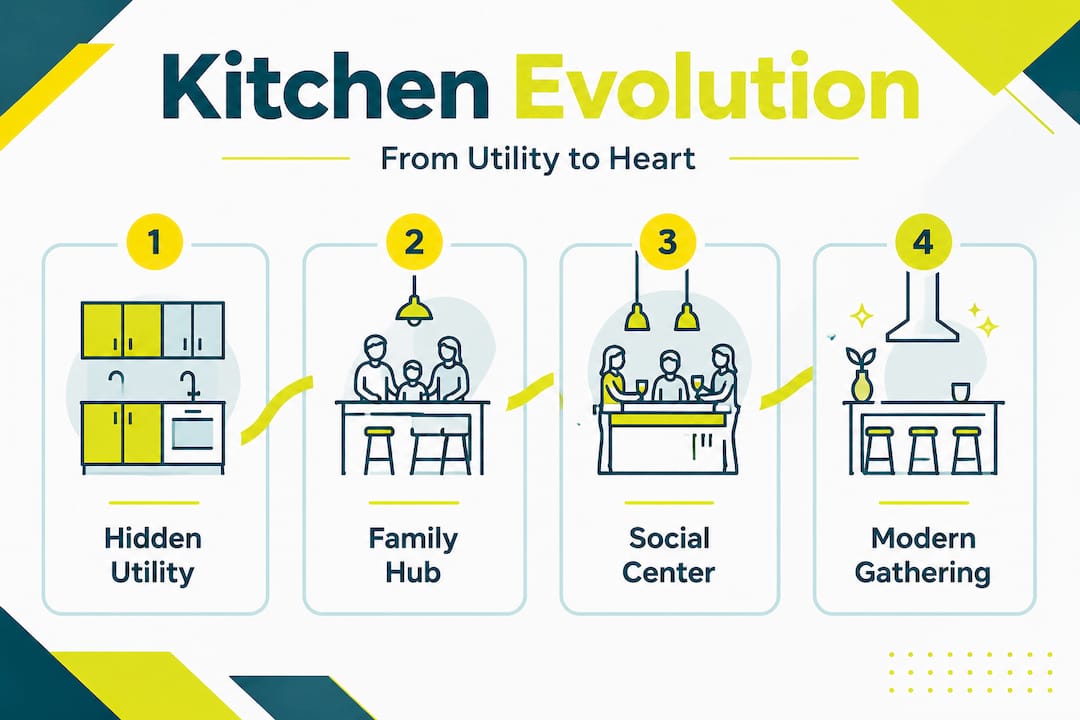
Kitchens weren’t always the open, inviting rooms we know today. As recently as the early twentieth century, kitchens were purely functional spaces, often separated from the rest of the home, staffed by domestic workers in wealthier households, and largely invisible to guests. The cook worked; everyone else entertained elsewhere.
The real turning point came after World War II, when smaller homes, changing family structures, and new appliances pushed kitchens to become more visible. Then came the open-plan revolution. Walls came down. The kitchen merged with the dining room, then the living room. Suddenly, the person cooking wasn’t isolated anymore. They were part of the conversation.
“Kitchens have evolved from utilitarian back-of-house spaces to central social hubs through open-plan designs,” reflecting a fundamental shift in how families organize their daily lives.
This transformation is well documented. As architecture and lifestyle experts have noted, the kitchen’s evolution into a social hub mirrors broader cultural changes around informality, togetherness, and the blurring of private and shared domestic spaces.
In Ottawa, this trend is clearly visible. Homes built in the Glebe, Westboro, and Kanata neighborhoods from the 1980s onward increasingly feature open-concept kitchens designed for both cooking and socializing. Even older homes are being updated to reflect this priority. Owners who are modernizing their kitchen often start with the cabinets precisely because they define the visual tone of the entire space.
Here’s a quick look at how kitchen design has shifted over the decades:
Era | Kitchen role | Design style | Social function |
Pre-1940s | Hidden utility room | Closed, separate | None, staff only |
1950s to 1970s | Family workspace | Semi-open, functional | Limited, family only |
1980s to 2000s | Emerging social space | Open-plan beginnings | Growing, informal |
2010s to present | Home’s social center | Fully open, multi-zone | Central, guests included |
The pattern is undeniable. As design expectations have grown, so has the pressure on homeowners to keep their kitchens looking great without spending a fortune on complete overhauls.
Why we gather in kitchens: psychological and social reasons
Have you ever noticed that no matter how beautifully a living room is set up, guests still end up crowding into the kitchen? There’s a real reason for that, and it goes well beyond food.
The kitchen is a multisensory comfort zone. Warmth from the oven, the aroma of food being prepared, the casual informality of leaning against a counter with a drink. These sensory cues signal safety and belonging in a way that a formal sitting room simply cannot replicate. Sociologists and behavioral researchers point to this combination of warmth, aroma, and informality as the core reason kitchens pull people in.
There’s also a powerful nostalgia factor. For most of us, the kitchen is where childhood memories live. Watching a parent or grandparent cook, sitting at the kitchen table doing homework, Sunday morning breakfasts. That emotional residue doesn’t disappear. When we walk into a kitchen that feels warm and lived-in, we naturally relax.
People gather in kitchens because the space activates multiple senses at once, making it feel instinctively safe, familiar, and social.
Here are the key factors that make kitchens natural gathering spots:
Warmth: Physical heat from cooking creates a welcoming, cozy atmosphere that draws people in, especially in Ottawa’s cold winters.
Aroma: The smell of food being prepared triggers positive emotional responses and social bonding almost immediately.
Informality: Kitchens don’t demand performance. There’s no need to sit properly or entertain with polish. People can simply exist comfortably.
Activity: Watching someone cook is naturally engaging. It creates easy conversation and a shared sense of participation.
Nostalgia: Kitchens carry memory. A familiar layout, a worn countertop, the sound of a specific pot. These cues create emotional warmth beyond the physical.
For Ottawa homeowners, this is important knowledge. You don’t need a designer kitchen to create a welcoming gathering space. What you need is a kitchen that feels right. Clean, cared-for, and inviting. That’s exactly what professional cabinet refinishing can deliver, and it’s one of the most well-recognized benefits of cabinet refinishing for families who want their kitchen to feel like the heart of the home again.
Pro Tip: If you want your kitchen to feel more welcoming right now, start with lighting and cabinet color. A fresh, light neutral on your cabinets can instantly brighten the space and make it feel more open and inviting without touching a single wall.
Modern kitchen layouts: Islands, zones, and Ottawa reality
Once we understand why everyone gathers in kitchens, it’s time to see how layout and design support social life and practical use.
For years, the “work triangle” (connecting the refrigerator, sink, and stove) was the gold standard for kitchen design. That concept is being phased out. Modern kitchens are increasingly designed around zones, each dedicated to a specific function: prep, cooking, storage, cleanup, and often a separate beverage or snack station. This zone-based design approach allows multiple people to use the kitchen simultaneously without constantly crossing paths.
Islands have been enormously popular for the past decade because they add workspace, seating, and a social focal point in one piece. However, 2026 is seeing a real shift. In smaller homes and condos, L-shaped and peninsula layouts are replacing islands because they improve flow and reduce clutter by up to 25% according to current design studies. Islands are great, but only if your kitchen has enough square footage to support them without creating a cramped, congested space.
For Ottawa homeowners evaluating layout options, here’s a simple comparison:
Layout type | Best for | Key advantage | Limitation |
Island | Large, open kitchens | Extra workspace and seating | Needs significant square footage |
Peninsula | Medium kitchens | Connected to counter, saves space | Less accessible on all sides |
L-shaped | Small to medium kitchens | Efficient flow, versatile | Limited counter space |
Galley | Narrow spaces | Maximum efficiency | Not ideal for socializing |
Open zone | Modern, open-plan homes | Multi-use, social-friendly | Requires strong organization |
So how should Ottawa homeowners approach this practically? Here’s a straightforward process we recommend:
Measure first. Before considering any layout change, measure your kitchen carefully. An island needs at minimum 42 to 48 inches of clearance on all sides to function properly.
Think about traffic. Where do people tend to stand and move? Map the natural flow before committing to any fixed element.
Prioritize zones. Even without a physical island, you can create a dedicated prep zone, cooking zone, and cleanup zone using smart storage and affordable Ottawa kitchen upgrades like cabinet refinishing to clearly define each area.
Consider the social sightline. Whoever is cooking should ideally be able to see and speak with people in the adjacent living or dining area. This is the essence of the modern kitchen layout.
Update the finish, not the footprint. If your layout already works reasonably well, the most cost-effective upgrade is often transforming your kitchen cabinets rather than moving walls or plumbing.
Pro Tip: Before spending money on a layout change, try rearranging any movable furniture or appliances for a week and observe how the space feels. Sometimes the layout is fine; it’s the visual noise from dated cabinets that makes the space feel dysfunctional.
Preserving a kitchen’s soul: Refinishing vs. replacing
After understanding layout choices, let’s focus on how you can update your kitchen while keeping its character and history alive.
There’s something important that gets lost in a total kitchen replacement, and it doesn’t show up on any contractor’s invoice. Call it social patina. The worn marks and small imperfections on your kitchen cabinets aren’t just signs of age. They’re a record of family life. The slight scuff where backpacks used to land. The faded corner where a child always leaned. These are the physical markers of a space that has genuinely been lived in.
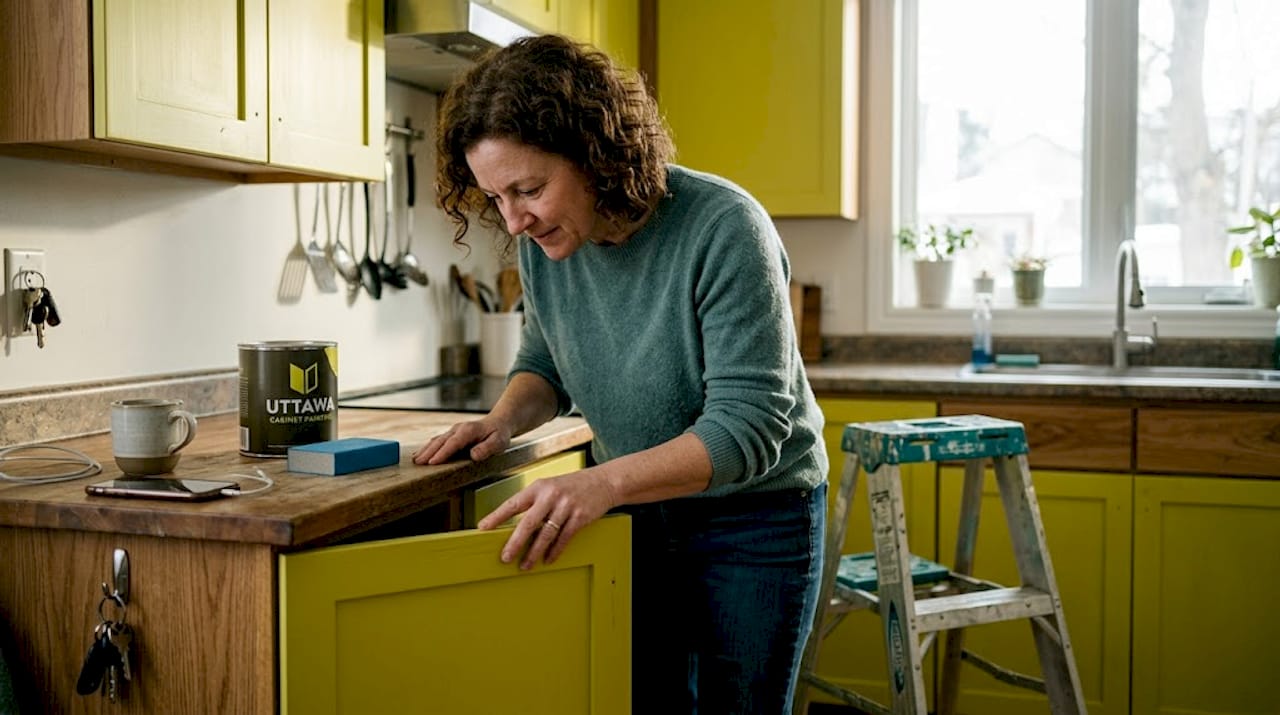
When you strip all of that out and install brand-new cabinets, you often get a space that looks pristine but feels unfamiliar. Sterile, even. It can take years before a replacement kitchen earns back the warmth of the one it replaced.
Refinishing takes a different approach. It restores both the look and the character of your existing cabinets by cleaning, prepping, priming, and applying a high-quality topcoat that gives a smooth, factory-finished look without erasing the original structure underneath.
Here’s what you keep when you choose refinishing over replacement:
The original layout, which already works for your family’s routines and habits
The existing structure, including any custom sizing or built-in features unique to your home
Significant cost savings, typically 70 to 80 percent less than full cabinet replacement
Environmental responsibility, since refinishing produces far less construction waste than a full gut-out
Sentimental continuity, the space still feels like your kitchen, just refreshed and renewed
Pro Tip: If you’re unsure whether your cabinets are worth refinishing, look at the box, not the door. If the cabinet boxes are structurally sound and solid, refinishing is almost always the smarter cost-effective kitchen upgrade. Doors and drawer fronts showing damage can often be replaced selectively while the rest is refinished.
The question of refinishing vs. refacing is also worth understanding. Refacing replaces the cabinet doors and drawer fronts while leaving the boxes in place. Refinishing, by contrast, works with what you already have entirely, applying new color and finish to the existing surfaces. Refinishing is generally the most affordable option and works beautifully when the cabinet construction is solid and the homeowner wants a fresh look without altering the kitchen’s fundamental character.
Most kitchen makeovers miss what really matters
Here’s an uncomfortable truth: many of the kitchen renovations we see celebrated online are actually working against the very qualities that make kitchens such powerful social spaces.
The trend toward pristine, surface-resistant materials like high-gloss lacquer, ultra-white quartz, and fingerprint-resistant coatings is, in many ways, a design movement that prioritizes appearance over experience. These surfaces resist the marks of daily life. Which sounds appealing in theory. But a kitchen that can’t be touched without leaving a visible trace becomes a space people feel nervous to actually use. It looks great in photos and functions poorly as a social hub.
We’ve also seen a return of the “back kitchen” concept, where a secondary scullery hides the mess from guests while the main kitchen stays photogenic. This is essentially returning to the pre-war model, where the kitchen’s social function was suppressed in favor of visual perfection. That is a significant step backward for anyone who actually wants their kitchen to feel like the heart of the home.
The psychology of kitchen layouts tells us something different. Intuitive layouts with clear sightlines, practical storage in the golden zone (between knee and shoulder height), and surfaces that feel welcoming rather than forbidding reduce everyday stress and encourage people to spend time in the space. A kitchen designed for real life, not for an Instagram post, will always outperform a showroom kitchen when it comes to actually bringing people together.
What Ottawa homeowners can take from this: don’t chase sterile perfection. Chase warmth, function, and visual freshness. A professionally refinished kitchen with a beautifully applied, durable finish delivers all three without asking you to sacrifice your kitchen’s authenticity or your budget. Maintaining authentic evolution, rather than wiping it out and starting over, is what local refinishing benefits are really about.
Ready to refresh your Ottawa kitchen?
If this article has reinforced what you already suspected, that your kitchen deserves some care and attention without a complete overhaul, we’d love to help. At Ottawa Cabinet Painting, we specialize in exactly this: giving your existing cabinets a professional, durable finish that makes your kitchen feel renewed without the disruption or expense of replacement. You can explore our full Ottawa cabinet painting services to see what’s possible for your specific space. If your kitchen is part of a broader refresh, our interior painting services can tie the whole look together beautifully. And if you’re still deciding whether refinishing is right for you, our before and after transformations show the real results we’ve delivered for Ottawa homeowners just like you.
Frequently asked questions
Why do people gravitate to the kitchen during gatherings?
Warmth, food aromas, and informality make kitchens a multisensory comfort zone for socializing, triggering positive emotional responses that more formal spaces simply can’t replicate.
How does cabinet refinishing fit into modern kitchen upgrades?
Cabinet refinishing affordably upgrades appearance and function while preserving the original character and social patina of the kitchen, making it a smarter choice than full replacement for most Ottawa homeowners.
What kitchen layouts are most popular in Ottawa homes now?
Zone-based, L-shaped, and peninsula layouts are trending for 2026 because they improve flow, reduce clutter, and work efficiently in small to medium-sized Ottawa homes.
Can a kitchen still be the heart of the home after renovations?
Yes, especially when you preserve authentic elements through refinishing. As research confirms, refinishing maintains the kitchen’s comfort and social feel in a way that full replacement often cannot.
Recommended
Comments