Why Ottawa Homeowners Choose Refinishing Over Replacement

TL;DR:
Cabinet refinishing offers Ottawa homeowners a cost-effective, minimally disruptive way to restore or update kitchen surfaces, saving up to 75% compared to full replacement. It takes only 5 to 10 days, preserves structurally sound cabinets, and reduces environmental waste and regulatory compliance concerns. Proper prep work and materials ensure a durable finish that lasts 8 to 15 years, making it a smart choice for many older homes.
Cabinet refinishing is defined as the process of cleaning, sanding, priming, and recoating existing cabinet surfaces to restore or transform their appearance without removing the cabinet boxes from the kitchen. This is the primary reason why homeowners choose refinishing: it delivers a near-new look at a fraction of the cost of full replacement, with far less disruption to daily life. For Ottawa homeowners weighing a kitchen update in 2026, the choice between refinishing and replacement is not just about aesthetics. It is about budget, timeline, and the practical reality of living through a renovation.
Why homeowners choose refinishing in Ottawa: the cost breakdown
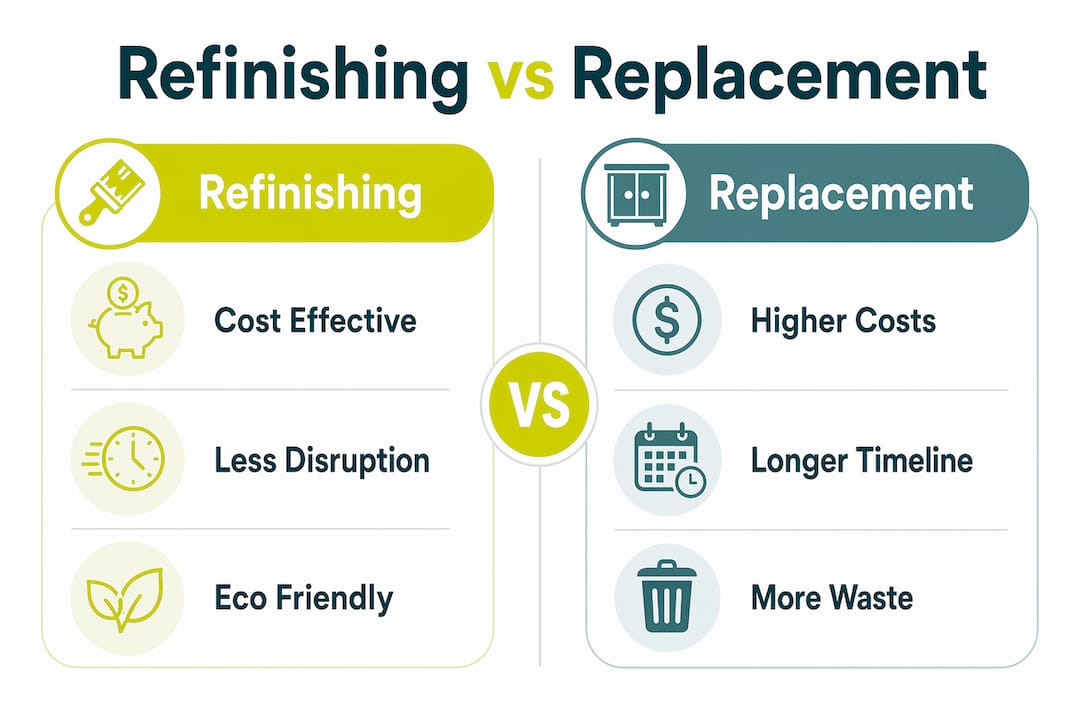
Refinishing kitchen cabinets typically costs 25 to 40% of what full replacement would cost, representing savings of up to 75%. That is not a minor difference. For an Ottawa kitchen with 20 to 30 cabinet doors, the gap between refinishing and replacement can easily reach tens of thousands of dollars.
The savings go beyond the obvious. Full replacement avoids secondary renovation costs such as demolition labor, disposal fees, and potential plumbing or electrical changes when new cabinet layouts do not match existing configurations. These hidden costs are what many homeowners underestimate when they first price out a replacement project. A quote for new cabinets rarely includes the full picture.
Cost Factor | Refinishing | Full Replacement |
Cabinet work | 25–40% of replacement cost | Full material and labor cost |
Demolition and disposal | Not required | Required, adds significant cost |
Plumbing or electrical changes | Rarely needed | Often needed for new layouts |
Project disruption | Minimal | Weeks of kitchen downtime |
Consider a typical Ottawa semi-detached home built in the 1980s. The kitchen has solid wood cabinet boxes in good structural condition, but the finish is dated and worn. Refinishing those cabinets to a modern color, such as a warm white or deep navy, costs a fraction of sourcing and installing new cabinetry. The layout stays the same, the hardware gets updated, and the result looks like a showroom kitchen.
Pro Tip: Get a written quote that separates labor from materials. This makes it easy to compare refinishing against replacement on a true apples-to-apples basis, including all secondary costs.
Understanding cabinet refinishing for resale value also matters here. A refreshed kitchen increases perceived home value without the capital outlay of a full renovation, which is particularly relevant in Ottawa’s competitive real estate market.
How does refinishing reduce timeline and disruption in Ottawa kitchens?
Speed is one of the most underappreciated benefits of refinishing. Cabinet refinishing projects generally take 5 to 10 days, compared to weeks or even months for full replacement projects that involve ordering, delivery, demolition, and installation. For a family that relies on their kitchen every day, that difference is significant.
Here is what a typical professional refinishing project looks like in terms of disruption:
Cabinet doors and drawer fronts are removed and taken to a controlled spray environment, keeping dust and fumes out of your living space.
The cabinet boxes remain in place, so your kitchen stays largely functional throughout the project.
Refinishing creates far less dust and debris than demolition, meaning no dumpster in the driveway and no contractor crews tearing through walls.
There is no need to temporarily relocate appliances or disconnect plumbing.
Final curing takes 7 to 14 days after the last coat, but cabinets are usable with light handling well before that.
Compare this to a full replacement project. Demolition alone can take a full day or more, followed by a waiting period for new cabinet delivery, then installation, then touch-up work. Many Ottawa homeowners report living without a functional kitchen for three to six weeks during a full replacement. That means takeout meals, temporary dish-washing setups, and a house that feels like a construction site.
Pro Tip: Schedule your refinishing project for a time when you can plan meals around a simplified kitchen setup for about a week. The disruption is genuinely minor compared to replacement, but a little planning makes it even smoother.

What environmental and regulatory advantages does refinishing offer Ottawa homeowners?
Refinishing is not just a financial decision. It carries real environmental and regulatory advantages that matter, especially for Ottawa homeowners in older properties.
Waste reduction. Refinishing preserves the existing cabinet boxes, doors, and hardware rather than sending them to a landfill. Full replacement generates a significant volume of construction waste, including particleboard, MDF, and old finishes that are difficult to recycle.
Preservation of quality materials. Many older Ottawa homes, particularly those built before the 1990s, have solid wood or high-quality plywood cabinet boxes that are structurally superior to much of today’s mass-market cabinetry. Refinishing keeps those materials in service.
Lead paint encapsulation. Homes built before 1978 may have lead paint on existing surfaces. Refinishing can encapsulate lead paint surfaces in older homes, reducing the need for expensive compliance and abatement procedures. Demolition, by contrast, disturbs those surfaces and triggers regulatory requirements.
Avoiding EPA RRP compliance costs. In older homes, avoiding EPA RRP lead paint disturbance rules through encapsulation rather than demolition reduces both project costs and delays. While Canadian regulations differ slightly from U.S. standards, the principle applies: disturbing lead paint surfaces requires certified contractors and specific disposal protocols that add time and expense.
These advantages are not theoretical. They are practical reasons why refinishing is the smarter choice for a large portion of Ottawa’s housing stock, much of which was built between the 1950s and 1980s.
When is refinishing the right choice versus full replacement in Ottawa?
Refinishing is not the right answer for every kitchen. The decision depends on the condition of your existing cabinets and your renovation goals.
Refinishing is appropriate only when the substrate is structurally sound. If the cabinet boxes are solid, the doors are flat and undamaged, and the hinges and hardware function properly, refinishing delivers excellent results. If there is structural damage beneath the surface, refinishing only masks the problem temporarily.
Condition | Refinishing Appropriate? | Notes |
Solid wood or plywood boxes, good structure | Yes | Ideal candidate for refinishing |
Surface scratches, worn finish, dated color | Yes | Core purpose of refinishing |
Minor delamination on door edges | Sometimes | Depends on extent; can be repaired |
Warping, buckling, or water damage | No | Replacement required |
Extensive mold or structural rot | No | Replacement required |
Signs that refinishing is the right call:
Your cabinet layout works well and you want to keep it.
The finish is worn, yellowed, or simply outdated in color.
Doors and drawer fronts are flat and undamaged.
You want a cost-effective kitchen upgrade without a full renovation.
Signs that replacement may be necessary:
Cabinet boxes show visible warping or moisture damage.
Hinges and drawer slides are failing due to structural issues, not just wear.
You need a fundamentally different kitchen layout.
Refinished surfaces can last 8 to 15 years with appropriate care and proper initial preparation. That is a meaningful lifespan, particularly when you consider that many homeowners update their kitchen aesthetics every 10 to 15 years regardless of cabinet condition.
What prep steps make refinishing last in Ottawa homes?
The quality of the prep work determines whether a refinished cabinet looks great for a decade or starts failing within the first year. This is not an opinion. Prep work quality determines refinishing durability far more than the choice of paint or finish brand.
The critical sequence for durable results:
Degreasing. Kitchen cabinets accumulate years of cooking grease and residue. Any finish applied over contamination will peel. A proper degreaser, applied thoroughly and rinsed clean, is non-negotiable.
Sanding to profile. Sanding creates a mechanical bond for the primer. Skipping this step or sanding too lightly is a recipe for finish failure within months.
Shellac-based or bonding primer. The right primer seals the substrate and provides adhesion for the topcoat. Using the wrong primer on wood or MDF surfaces leads to bleed-through and poor adhesion.
Multiple thin topcoats. A factory-finished look comes from building up thin, even coats rather than applying one thick coat. Each coat needs adequate dry time before the next is applied.
Cabinet refinishing timelines hinge on drying and curing times rather than paint application speed. Homeowners should wait 7 to 14 days after the final coating before returning to normal cabinet use. Rushing this step causes surface damage that is entirely avoidable.
Pro Tip: Ask any refinishing contractor specifically how they handle the degreasing and priming steps. A contractor who cannot explain their prep process in detail is likely cutting corners that will cost you later.
Key takeaways
Cabinet refinishing is the most cost-effective way for Ottawa homeowners to update kitchen cabinetry, delivering up to 75% savings over replacement while preserving structurally sound materials and minimizing project disruption.
Point | Details |
Cost savings are substantial | Refinishing costs 25 to 40% of replacement, with additional savings from avoided demolition and secondary work. |
Timeline is dramatically shorter | Professional refinishing takes 5 to 10 days versus weeks for full replacement, keeping kitchen disruption minimal. |
Structural soundness is the key qualifier | Refinishing works when cabinet boxes are solid; warping or water damage requires replacement instead. |
Prep work determines durability | Degreasing, sanding, and proper priming are what make a refinished finish last 8 to 15 years. |
Environmental benefits are real | Refinishing reduces landfill waste and, in older Ottawa homes, avoids disturbing lead paint surfaces. |
Our honest take on refinishing for Ottawa kitchens
We have worked on hundreds of Ottawa kitchens, and the pattern is consistent. Homeowners who choose refinishing are almost always glad they did. The ones who hesitate usually do so because they assume refinishing is a compromise. It is not. Done properly, a professionally refinished cabinet is indistinguishable from a factory-finished one.
What we have learned is that the biggest misconception is about longevity. People assume that because refinishing costs less, it must wear out faster. The reality is that a well-prepped, professionally applied finish on a solid cabinet box will outlast a budget replacement cabinet by years. The substrate matters more than the finish.
We also see homeowners underestimate how much of their renovation budget gets consumed by the secondary costs of replacement. Demolition, disposal, new hardware, potential plumbing adjustments, and the weeks of kitchen downtime add up fast. Refinishing sidesteps all of that. For Ottawa homeowners who want a genuinely updated kitchen without gutting their savings, refinishing is not the budget option. It is the smart option.
The one thing we always tell clients: do not rush the prep. Patience in the first two days of a project determines how the finish holds up over the next ten years. That is true whether you hire us or anyone else.
— Ottawa
Transform your Ottawa kitchen cabinets with Ottawacabinetpainting
Ottawacabinetpainting specializes in professional cabinet refinishing for Ottawa homeowners who want a high-end kitchen update without the cost or chaos of full replacement. Our process covers thorough degreasing, sanding, shellac-based priming, and premium topcoat application, backed by a 6-year warranty on our work. Projects are typically completed in around ten days, with minimal disruption to your household. Explore our interior refinishing services to see what a professional finish looks like, or visit our cabinet painting page to request a free quote. Your kitchen deserves a finish that lasts.
FAQ
How much does cabinet refinishing cost compared to replacement?
Cabinet refinishing typically costs 25 to 40% of full replacement, representing up to 75% in savings. Additional savings come from avoided demolition, disposal fees, and potential plumbing or electrical work.
How long does a cabinet refinishing project take in Ottawa?
Most professional refinishing projects take 5 to 10 days from start to finish, with a full cure time of 7 to 14 days before normal cabinet use. This is significantly faster than full replacement, which can take several weeks.
When should I refinish rather than replace my cabinets?
Refinishing is the right choice when your cabinet boxes are structurally sound and the issues are cosmetic, such as a worn finish or outdated color. Severe warping or moisture damage typically requires replacement instead.
How long will refinished cabinets last?
With proper prep and professional application, refinished surfaces last 8 to 15 years depending on usage and finish quality. Prep work quality is the single biggest factor in long-term durability.
Is refinishing a good option for older Ottawa homes with lead paint?
Yes. Refinishing encapsulates lead paint surfaces rather than disturbing them, which avoids the regulatory requirements and abatement costs triggered by demolition. This makes refinishing particularly practical for Ottawa homes built before the late 1970s.
Recommended
Comments