Cabinet Repair in Ottawa: Save Money, Skip the Reno

TL;DR:
Cabinet repair restores damaged kitchen cabinets and can last up to 15 years when properly done.
Proper surface cleaning, priming, and curing are essential to ensure durability and avoid failure.
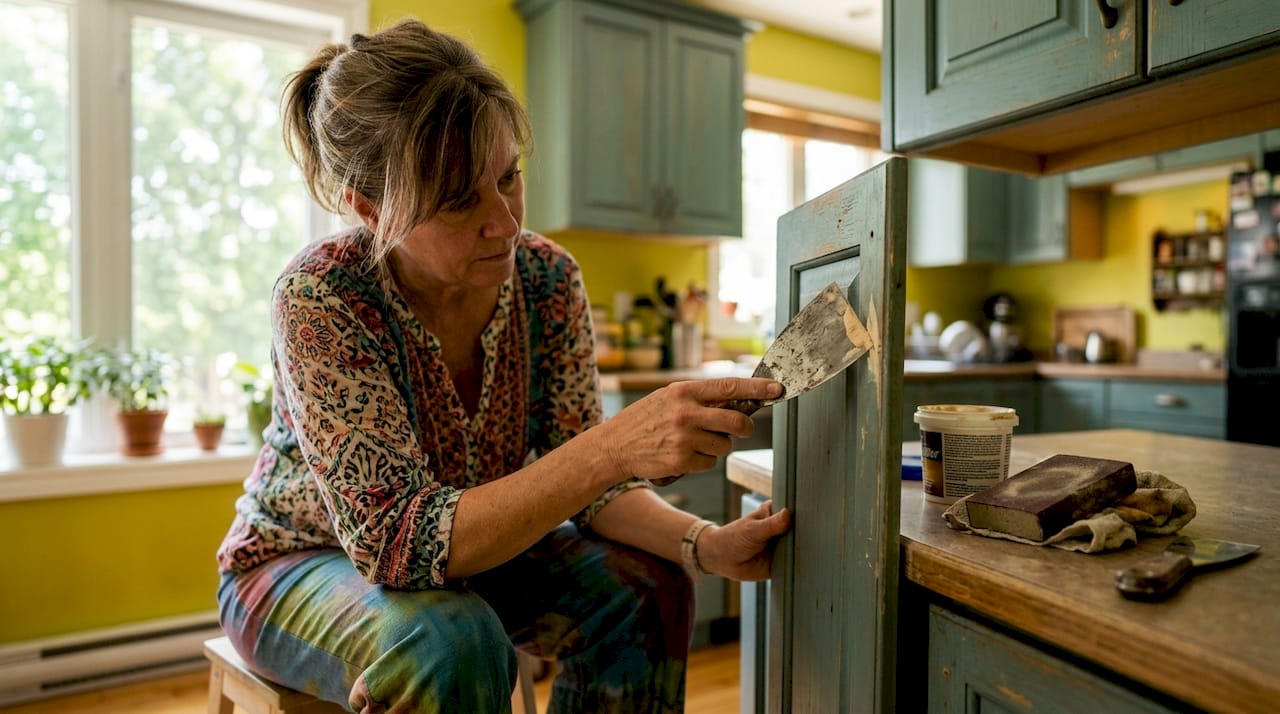
Cabinet repair is the process of restoring damaged or worn kitchen cabinets to like-new condition, saving Ottawa homeowners thousands of dollars compared to full replacement. The industry term for this work is “cabinet restoration,” which covers everything from fixing loose hinges and scratched surfaces to addressing water damage and refinishing worn finishes. A properly done restoration project can last 8 to 15 years under normal use when cabinet boxes are structurally sound and surfaces are properly prepped. That kind of longevity makes repair one of the most cost-effective decisions you can make for your Ottawa kitchen.
What tools do you need for cabinet repair in Ottawa?
The right tools make the difference between a repair that holds for years and one that fails within months. Gathering everything before you start saves time and prevents costly mid-project mistakes.
Hand tools you will need:
Screwdrivers (flathead and Phillips, multiple sizes)
Putty knife and flexible filling knife
Sanding block with 80, 120, and 220-grit sandpaper
Tack cloths for dust removal
Painter’s tape and drop cloths
Small foam rollers and quality synthetic brushes
Power tools and specialty items:
Orbital sander for larger flat surfaces
Cordless drill with assorted bits
Cabinet hinge adjustment tool or hex key set
Repair materials to stock:
Wood filler or two-part epoxy filler for deep gouges
Shellac-based or bonding primer (not standard wall primer)
Cabinet-grade paint or topcoat in your chosen finish
TSP substitute cleaner for degreasing
Wood glue and toothpicks for stripped screw holes
Caulk for gaps between cabinet frames and walls
Ottawa homeowners can source professional-grade wood fillers and bonding primers at local hardware stores. Choosing cabinet-grade products over general-purpose alternatives pays off in finish durability, especially given Ottawa’s humidity swings between summer and winter.
Pro Tip: Buy a small extra can of your topcoat color and store it. Ottawa kitchens take a beating, and touch-ups two years from now are much easier when you have an exact color match on hand.
How do you fix common cabinet problems step by step?
Most kitchen cabinet issues fall into four categories: surface scratches and dents, loose or misaligned doors, stripped screw holes, and water damage. Each requires a specific approach.
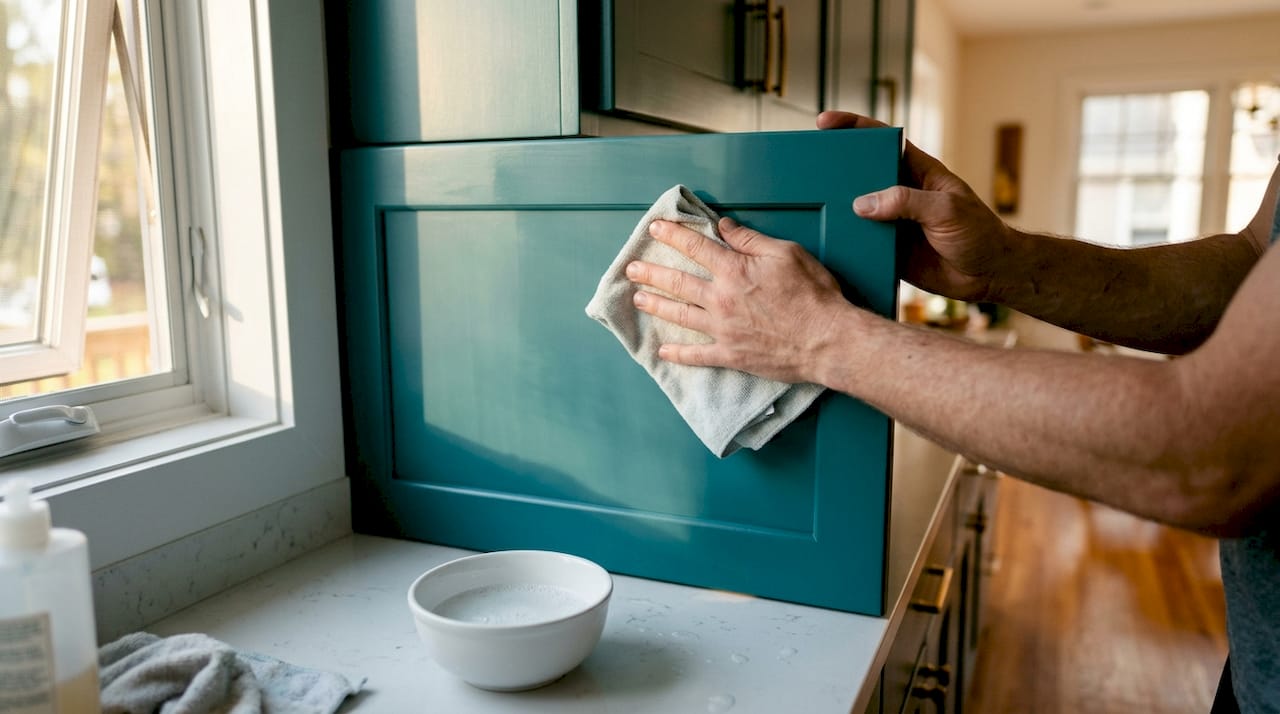
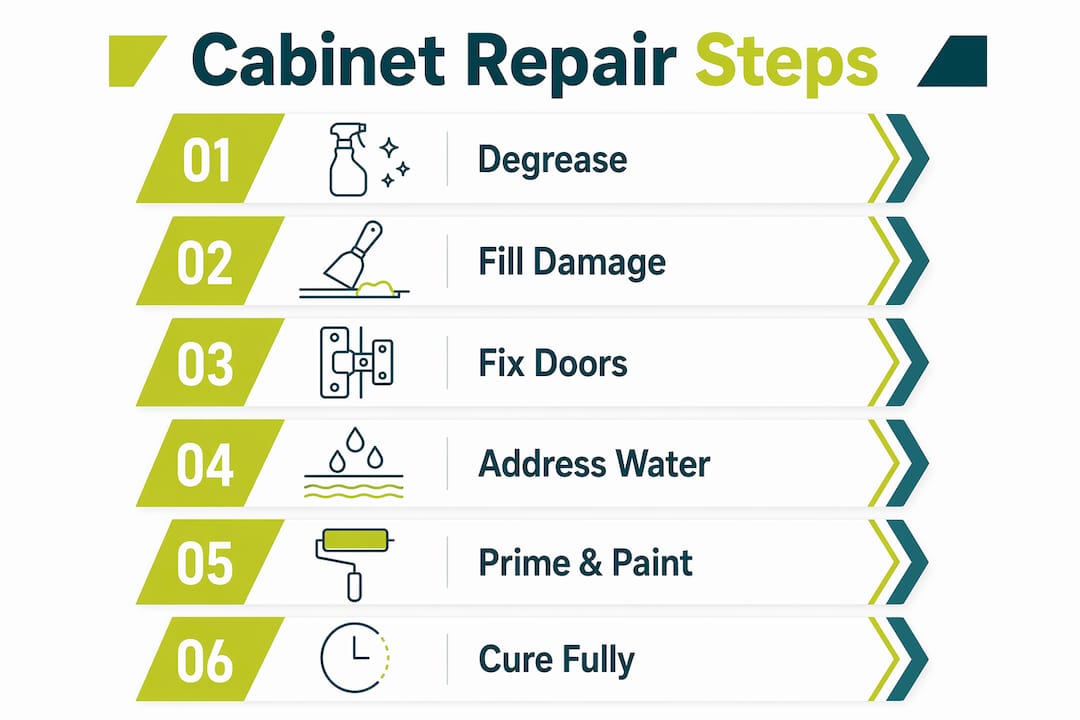
Step 1: Degrease and clean every surface
Degreasing with TSP substitutes is the single most important prep step. Standard household cleaners leave behind a film that causes paint to peel within months. Scrub all cabinet surfaces with a TSP substitute solution, rinse thoroughly, and let everything dry completely before touching sandpaper.
Step 2: Fill scratches, dents, and gouges
Apply wood filler to any damaged areas using a flexible putty knife. Press the filler slightly above the surface level, since it shrinks as it dries. Once dry, sand flush with 120-grit sandpaper, then follow with 220-grit for a smooth finish. For deep gouges, a two-part epoxy filler creates a harder, more durable repair than standard wood filler.
Step 3: Fix loose or misaligned doors
Loose doors almost always trace back to stripped screw holes, not the hinges themselves. The toothpick and glue technique creates a reliable anchor: dip several toothpicks in wood glue, pack them into the stripped hole, let the glue cure fully, then snap off the excess flush with the surface. Drive the original screw back in and the grip holds firm. Simply tightening the screw without filling the hole is a recipe for the same problem recurring within weeks.
Pro Tip: Photograph all cabinet doors before removing them and label each hinge with masking tape. This saves hours during reassembly and keeps door alignment accurate.
Step 4: Address water damage and swelling
Solid wood cabinets are far easier to restore than particleboard or laminate when water damage is involved. For solid wood, let the area dry completely, sand back the swollen grain, fill any gaps with epoxy filler, and prime before repainting. Particleboard that has swollen significantly often cannot be restored to a flat surface. Water damage combined with visible mold is a strong signal that replacement of that cabinet section is the better call.
Step 5: Prime and paint
Shellac-based or dedicated bonding primers outperform standard wall primers in kitchen environments. Apply one coat of primer, let it cure per the manufacturer’s instructions, then sand lightly with 220-grit before applying your topcoat. Two thin coats of cabinet-grade paint produce a more durable finish than one thick coat.
Step 6: Allow full curing before use
The finish may feel dry to the touch within hours, but full curing takes 7 to 14 days. Loading shelves or closing doors with force before the finish cures fully causes indentations and chipping that are difficult to fix. Treat newly finished cabinets gently for at least two weeks.
Repair Type | DIY Difficulty | Key Material | Time to Complete |
Surface scratches | Low | Wood filler, 220-grit sandpaper | 1–2 hours |
Stripped screw holes | Low | Toothpicks, wood glue | 2–4 hours including cure |
Water damage (solid wood) | Medium | Epoxy filler, bonding primer | 1–2 days |
Full refinishing | Medium-High | Bonding primer, cabinet-grade paint | 3–7 days |
When should Ottawa homeowners call a professional?
DIY repairs work well for surface-level issues. Structural problems, large-scale refinishing, and finish quality that needs to look factory-smooth are situations where professional help protects your investment.
Signs you need a professional:
Cabinet boxes are warped, cracked, or show signs of mold inside
Multiple doors are misaligned and hinge adjustment does not resolve the issue
The existing finish is peeling in large sections rather than isolated spots
You want a uniform, showroom-quality finish across all cabinets at once
Water damage has reached the cabinet box structure, not just the surface
Professional cabinet refinishing averages about $3,000, compared to $7,230 for full refacing. That gap is significant. For Ottawa homeowners who want a fresh look without touching the cabinet boxes, refinishing delivers the best return. You can also review the cost differences between methods to decide which approach fits your budget.
Professional projects typically take 3 to 14 days, which means minimal disruption to your kitchen routine. A reputable Ottawa contractor will walk you through a detailed quote, explain the prep process, and provide a written warranty. Ottawacabinetpainting backs its work with a 6-year warranty, which is a meaningful assurance when you are investing in a finish meant to last a decade or more.
When vetting a local contractor, ask specifically about their primer choice, how many coats they apply, and whether they spray or brush. Sprayed finishes produce a smoother result on flat cabinet doors. A contractor who cannot answer those questions clearly is worth passing on.
What mistakes cause cabinet repairs to fail in Ottawa?
Most failed repairs share the same root causes. Avoiding these mistakes is what separates a repair that lasts years from one that looks worse than the original damage within months.
Skipping degreasing. Kitchen grease is invisible once it dries. Painting over it causes the finish to peel, sometimes within weeks. Always use a TSP substitute, not dish soap or all-purpose spray.
Using the wrong primer. Standard wall primer does not bond well to cabinet surfaces, especially laminate or previously painted wood. Primer choice directly impacts finish durability in humid, greasy kitchen environments.
Rushing curing time. Premature stress on a newly finished surface causes permanent indentations and chipping. Wait the full 7 to 14 days.
Ignoring structural damage. Painting over swollen particleboard or cracked cabinet boxes hides the problem temporarily. The damage continues underneath and the finish fails faster.
Over-tightening screws without filling holes. This strips the hole further and makes the next repair harder.
The most common mistake we see Ottawa homeowners make is painting cabinets without proper degreasing and priming. The finish looks fine for a few weeks, then starts peeling at the edges. Doing the prep work right the first time is what makes a repair last 10 years instead of 10 months.
For ongoing maintenance, wipe cabinet surfaces with a damp cloth rather than abrasive cleaners. Avoid hanging wet dish towels on cabinet doors, since prolonged moisture exposure is the leading cause of finish breakdown near the sink. Check hinges twice a year and tighten any that feel loose before they strip.
Key Takeaways
Proper surface preparation, correct primer selection, and full curing time are the three factors that determine whether a cabinet repair lasts years or fails within months.
Point | Details |
Degreasing is non-negotiable | Use a TSP substitute before any sanding or priming to prevent finish failure. |
Primer type determines durability | Shellac-based or bonding primers outperform standard wall primers in kitchen environments. |
Curing takes up to 14 days | Avoid stress on newly finished cabinets for a full two weeks to prevent chipping. |
Structural damage needs professional assessment | Water damage, mold, or warped boxes often require professional repair or section replacement. |
Professional refinishing costs far less than refacing | At roughly $3,000 versus $7,230, refinishing delivers a fresh look at a fraction of the cost. |
What I’ve learned about cabinet repair after years in Ottawa kitchens
Ottawa kitchens face conditions that most general repair guides do not account for. The humidity swings here are real. Cabinets near exterior walls or poorly insulated spaces absorb moisture in winter and dry out in summer. That cycle stresses finishes and loosens joints faster than in more temperate climates. Choosing a paint or topcoat with some flexibility, rather than a rigid enamel, helps the finish move with the wood instead of cracking.
The most important thing I tell Ottawa homeowners is this: catch problems early. A loose hinge costs almost nothing to fix today. Left alone for a year, it strips the screw hole, misaligns the door, and eventually damages the cabinet frame. The same principle applies to small scratches. A $10 touch-up kit handles a scratch in 20 minutes. Ignoring it lets moisture in, and moisture turns a scratch into a swelling problem.
I also think the DIY versus professional question gets framed wrong. It is not about skill level. It is about the scope of the project. Fixing one door, filling a scratch, or tightening hinges? Do it yourself. Refinishing 30 cabinet doors to a consistent, factory-smooth finish? That is where professional equipment and experience produce results that DIY simply cannot match. Knowing which category your project falls into saves you time, money, and frustration.
For finishes, I consistently recommend water-based alkyd paints for Ottawa kitchens. They cure hard like oil-based paint but clean up with water and off-gas far less. They hold up to grease, steam, and cleaning better than standard latex, and they look sharp for years when applied over a proper bonding primer.
— Ottawa
How Ottawacabinetpainting can refresh your kitchen cabinets
If your cabinets need more than a quick fix, Ottawacabinetpainting offers professional cabinet painting and refinishing tailored specifically for Ottawa homeowners. The process covers thorough prep work, shellac-based priming, and a sprayed topcoat that delivers a factory-smooth finish built to last. Every project comes with a 6-year warranty, so you are not just getting a fresh look. You are getting lasting protection. Reach out for a free spray painting quote and find out what your kitchen could look like without the cost or chaos of a full renovation.
FAQ
How much does cabinet repair cost in Ottawa?
DIY materials for basic repairs typically run $150 to $400, while professional refinishing averages around $3,000. Full refacing costs significantly more, averaging $7,230.
How long does a professional cabinet refinishing project take?
Most professional refinishing projects in Ottawa take 3 to 14 days from start to finish, with minimal disruption to your daily kitchen use.
Can water-damaged cabinets be repaired without replacement?
Solid wood cabinets with surface-level water damage can often be sanded, filled, and refinished. Particleboard cabinets with significant swelling or mold usually require section replacement rather than repair.
What is the best primer for kitchen cabinet repair?
Shellac-based or dedicated bonding primers are the best choice for kitchen cabinets. They bond to previously painted, laminate, and hardwood surfaces far better than standard wall primers.
How long should I wait before using cabinets after refinishing?
Wait a full 7 to 14 days before loading shelves or closing doors with normal force. The finish may feel dry within hours, but full curing takes up to two weeks.
Recommended
Comments